Jimi Hendrix’s 1961 Epiphone Wilshire

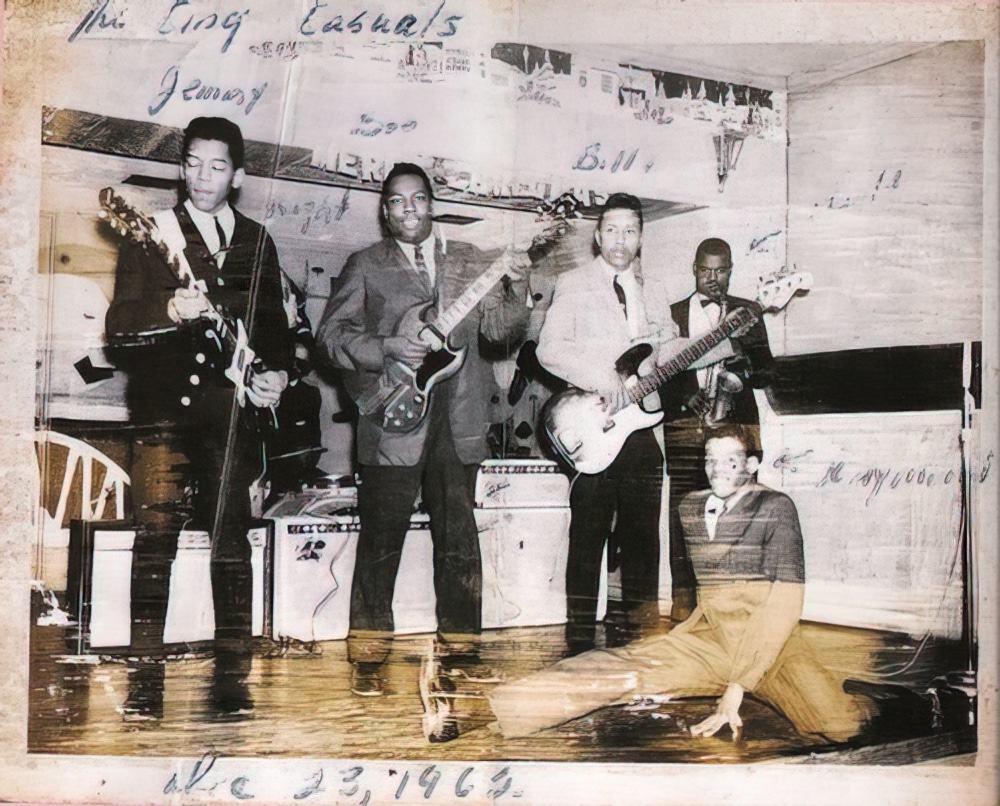
In the early 1960s, Jimi Hendrix began to carve his path in the world of music. It was during this period, specifically in 1963, that he started to make his mark as part of the King Casuals band, performing at the Club Del Morocco.
Among the guitars that Hendrix was known to have played during this period, the 1961 Epiphone Wilshire stands out as one of the cooler ones. Although not as famous as some of his later instruments, the Epiphone Wilshire was a significant part of Hendrix’s early exploration and mastery of the electric guitar, contributing to the distinctive sound that would define his musical legacy.
The King Kasuals
Hendrix transitioned from Clarksville to Nashville around late 1962, following Billy Cox’s discharge from the army. In Nashville, the band they formed secured a regular gig at Club Del Morocco. This opportunity marked Hendrix’s first steady job as a musician, and it is likely that he primarily used the Epiphone during this period.

Jimi’s Epiphone featured a solid mahogany body with a red finish, two P-90 pickups, a black (Tortoiseshell?) pickguard, and dot fretboard inlays. The inlay on the 17th fret seems to cover almost the entire space between the frets. It remains unclear whether this was a modification, a simple sticker, or something similar.
Notably, the guitar also included a Vibrola tremolo bridge, which adds an element of confusion. According to GuitarHQ’s model history [Epiphone Wilshire model guitars 1959 to 1970], the tremolo was installed on models made between 1959 and 1961, and between mid-1962 and 1963. Jimi’s guitar aligns with the description of the 1961 model, which, as one might guess, did not come with a tremolo.
There are a couple of possible explanations for this discrepancy. The guitar may have been modified, either by a previous owner or by Jimi himself. Alternatively, there might have been a 1961 model that featured both the black P90 pickups and the Vibrola tremolo.
Pickguard painted white?
In the book Jimi Hendrix Gear [Jimi Hendrix Gear, Michael Heatley – p.34], there is an anecdote suggesting that Jimi painted the pickguard white at some stage. Upon examining photos from around this era, one can indeed spot what appears to be an Epiphone featuring a white pickguard, black P90s, and block inlays (see below).
It is essential to note that, based on information available online, there doesn’t seem to have been a production Wilshire with block inlays in the early 60s. Furthermore, the guitar in the second photo appears to be left-handed, as the control knobs are on the bottom side while Jimi is holding it. In contrast, the Wilshire in the first photo is evidently right-handed.
As a result, the guitar that Jimi is holding in the second photo is most likely an Epiphone Crestwood.
The story of the pickguard being painted white might simply be a consequence of incorrectly identifying the guitar as the same Wilshire that Jimi was seen using in other photos. This confusion is entirely understandable, as even we made the same mistake on this exact page until someone pointed out the error.
Modern take on the WIlshire
The Epiphone Wilshire, with its distinctive double-cutaway body and sharp, angular lines, has been a notable model since its inception.
It’s association with Hendrix undoubtedly contributed to the guitar’s legendary status and influenced Epiphone’s decision to re-issue the Wilshire. The modern version of the Epiphone Wilshire was re-released in 2020 and continues to be available, offering players a piece of that iconic history combined with contemporary features. In fact, is is one of the models that we recomended in our list of best guitars with P90s.
Feedback
GroundGuitar counts on your criticism and feedback. In case you notice anything wrong with the information posted on this page, or you have knowledge of something that you would like to share, be sure to leave a comment below.
In case you want to talk to me directly and privately, please use the Contact Form and I will get back to you as soon as possible. (Dan)