Jimi Hendrix’s Marshall Supa Fuzz

There is a scan of a receipt from a Sound City music store in London from January 1967 showing that Jimi purchased a Marshall Supa Fuzz. [The Jimi Hendrix Experience, a collection of original Sound City receipts 1966 – 1967] This receipt was recently auctioned off, alongside another receipt for a for Fender Telecaster Bass for Noel Redding.
Please note that although the receipt reads Marshall “Super” Fuzz instead of “Supa”, it is likely that that was just an error from the person who wrote the receipt. There was, however, a pedal sold around the same time with a similar name – the Univox Super Fuzz, but a simple error in writing is a far more likely possibility. Next to that, Jimi was photographed using the Marshall Supa Fuzz just four days after purchasing it – on January 24, 1967, at The Marquee Club.
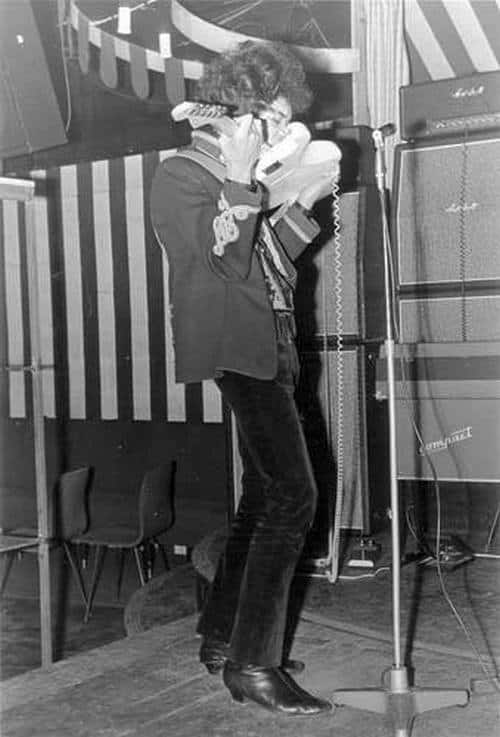
From the photo above we can see that Jimi’s Supa Fuzz was a 1966 version, or MKI, with control knobs closer together than on the MKII model. This model was based on the Tone Bender MKI circuit, with a modified tone circuit to give the Marshall version a different sound. Interestingly, on this MKI model of the Supa Fuzz, the fuzz was internally fixed at maximum.
You can read more about the history of this pedal, and the Tone Bender at The Tone Bender Timeline.
Studio Use
It’s very hard to tell whether Jimi ever used this pedal in the studio, or whether this was simply a short-term fuzz that he didn’t get to use much aside from a few odd occasions.
To try and figure something out – in January 1967 Jimi met Roger Mayer, and used a pedal that he developed, Octavia, to record the solo on “Purple Haze”, and on some parts of “Fire”. Roger notes that Jimi used the Octavia after a fuzz unit, and based on what Roger said, it seems that the fuzz effect was a completely separate unit at that time (later on, Roger would combine the fuzz box into the Octavia).
Jimi placed the Octavia after a fuzz and wah unit in most cases so it would react to the combined effects of both the wah and one or more fuzz boxes. […] It then became obvious that both a driver section and the Octavia section should be combined into one box.
Roger Mayer – Octavia
Unfortunately, Roger does not go into specifics, so we don’t know whether the fuzz used on the track was a Marshall Supa Fuzz, or something like an Arbiter Fuzz Face, which Hendrix used extensively later on. There is a chance that Jimi used the Supa Fuzz to some extent, but we’ll probably never know for sure.
Feedback
GroundGuitar counts on your criticism and feedback. In case you notice anything wrong with the information posted on this page, or you have knowledge of something that you would like to share, be sure to leave a comment below.
In case you want to talk to me directly and privately, please use the Contact Form and I will get back to you as soon as possible. (Dan)
I may have missed something about the criteria used to generate your list. It seems quite exhaustive until you get to Effects. You make no mention of Octavia, Fuzz face, Uni-vibe, and of course, Wah-wah.
I haven’t had the time to finish the list yet. All those will be added at some point. Cheers.