Jimi Hendrix’s 1967 Gibson Flying V (Hand-painted)

The earliest photo of Jimi playing this guitar on stage seems to date to around July 1967. This was at the beginning of The Monkees tour, so possibly at Miami Beach on July 8, 1967.
Based on this, it is likely that Jimi purchased it in the US – perhaps in early July when he was staying in New York (Manny’s Music Shop in NYC was a very popular guitar store among rock stars back then).
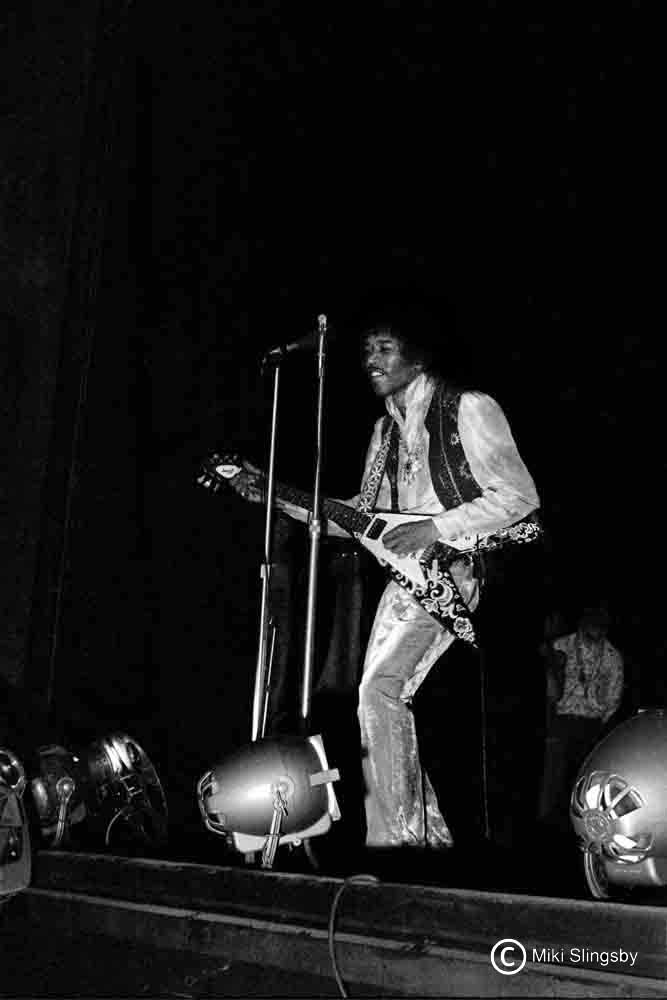
From late August 1967, and Jimi’s return to the UK, the Gibson became one of his main go-to guitars. It was seen on numerous occasions either being used or sitting on stage while Jimi was playing his white Stratocaster.
It can be seen in photos taken during the short European tour in early September 1967 (Germany, Sweden), the famous backstage photos with Jeremy Thorpe at The Royal Festival Hall on September 25th [Jeremy Thorpe with Jimi Hendrix after the concert by The Jimi Hendrix Experience at Royal Festival Hall guitar tuxedo jewelry MSI – Alamy], and on the French TV program “Dim Dam Dom” filmed sometime in mid-October (video below).
The 1967 Gibson Flying V continued being used until the end of 1967, and shortly into 1968. By March 1968 however, the guitar was out of the rotation it seems, and Jimi went back to playing Stratocasters exclusively (eventually he picked up a Gibson Les Paul Custom instead).
The Flying V in Studio
There doesn’t seem to be any proof that Hendrix used this Flying V on any of the songs in the studio. Electric Ladyland was recorded during the time Hendrix had the guitar, but just based on the sound, it is likely that they were all done on a Strat. The possibility of it being used on the record is still there, of course.
There are some rumors that All Along the Watchtower was recorded on this guitar, but again – no real proof behind it. The best we could find is a story from Kathy Etchingham, who said that Jimi had brought the wrong guitar to the recording, and sent Kathy back to the apartment to pick up a different one [Through Gypsy Eyes, Kathy Etchingham] She does not mention the model, or anything at all really about the guitar, unfortunately, but this could be interpreted as Jimi using more than just a Strat. The only person who would probably know the answer to this is Dave Mason (who played the twelve-string acoustic on the track), but we can’t find any mention of the subject from him.
Current Whereabouts
The guitar was owned at some point by RockStarGuitars, but it recently changed owners. According to the info posted on their website (see Jimi Hendrix’s 1967 Gibson Flying V – RockStarGuitars) the guitar was given by Jimi to Mick Cox in 1969, and after changing hands a few times, it ended up with Rock Stars Guitars founder David Brewis.
Important to note that the current finish on the guitar is not the original done by Jimi himself, but restoration was done by an artist commissioned by Brewis.
Embed from Getty ImagesFeedback
GroundGuitar counts on your criticism and feedback. In case you notice anything wrong with the information posted on this page, or you have knowledge of something that you would like to share, be sure to leave a comment below.
In case you want to talk to me directly and privately, please use the Contact Form and I will get back to you as soon as possible. (Dan)
it just kills me that Jimi gave this iconic artifact to Mick Cox in 1969…and he striped off Jimi’s hand-painted finish because he wanted a wood tone guitar. It’s like using paint remover on the Mona Lisa because you need a piece of canvas. They repainted the V as it appeared from photos, but Jimi’s aura was forever altered on this particular guitar.
Cheering you up to know that dunderhead move surely stripped $$$$$ of value from it.
Hi. Very thorough blog! Like it! :)
However, the link to Rockstarsguitars is broken. Try this…
https://www.rockstarsguitars.com/products/jimi-hendrix-exp/jimi-hendrix/jimi-hendrixs-1967-gibson-flying-v/
Cheers!
It’s fixed, cheers.
This guitar is currently part of the exhibit “Play it loud” original instruments of Rock on display at the Metropolitan Museum of Art in New York City.
Did you by any chance manage to snap a photo of it? It would be cool to see the guitar in its current state. Cheers, Dan.
I took a few. Attached.
These are great. Can I embed them in the actual post above in full size?