Jimi Hendrix's Guitars and Gear
Introduction
Jimi Hendrix is often celebrated as one of the most influential guitarists in the history of rock music. Born in Seattle in 1942, his innovative approach to the electric guitar, with its explosive sound and expressive style, reinvented the potential of the instrument. His ability to merge different genres of music and his experimental use of guitar effects created a groundbreaking musical legacy that continues to inspire musicians today.
His iconic Fender Stratocaster became almost synonymous with his name; it was a vessel through which he channeled his creativity into unforgettable performances. Hendrix’s mastery of the guitar was not just in his technical skill, but also in his emotional expression, often embodying the cultural and social complexities of his time. His technique and sound, characterized by feedback, distortion, and the extensive use of wah-wah and Octavia effects, were revolutionary.

The impact of Hendrix’s brief yet significant career is evident in the enduring popularity of his music and the reverence with which he is held by succeeding generations of guitarists. His performances at Woodstock and Monterey Pop Festival encapsulated the spirit of an era and cemented his status as a musical icon. Hendrix’s intimate relationship with his guitar allowed him to express his vision with a clarity and intensity that remains unmatched, securing his legacy as a pivotal figure in the world of rock guitar.
List of Guitars, Amps, Effects, and Accessories used by Jimi Hendrix
Jimi Hendrix's Electric Guitars
1957 Supro Ozark 1560s
 Continue Reading
Jimi Hendrix’s first electric guitar is a subject of much debate among music historians and enthusiasts.
According to some sources, Jimi’s first electric guitar was a Supro that he received from his father, who reportedly bought it in the Myers Music Shop in Seattle in 1959 for $89 [Hendrix Gear, by Michael Heatley]. However, other sources dispute this claim, stating that the story is actually connected to Jimi’s second electric guitar, a Danelectro [Becoming Jimi Hendrix, Steven Rody].
Despite the confusion around his first electric guitar, it is widely believed that Jimi played the Supro with his band, The Rocking Kings, circa 1959. The guitar was reportedly stolen from the bandstand at The Birdland Club in 1960.

Young Jimi Hendrix playing his white Supro Ozark guitar. 119591960s Danelectro Bronze Standard
Continue ReadingFollowing the theft of his Supro, with support from his father, Jimi Hendrix acquired a 1960s Danelectro Bronze Standard guitar, marking it as his second electric guitar in chronological order.
Intriguingly, Hendrix himself claimed that the Danelectro was, in fact, his very first guitar. This raises the possibility that the Supro may have been a borrowed instrument. This theory is further supported by the fact that he was only documented playing the Supro on one occasion.
When I was seventeen, I formed this group with some other guys, but they drowned me out. I didn’t know why at first, but after about three months I realized I’d have to get an electric guitar. My first was a Danelectro, which my dad bought for me. Must have busted him for a long time.
Starting At Zero: His Own Story by Jimi Hendrix

Jimi Hendrix in the Army holding a Danelectro Bronze Standard guitar. Photo credit: Unknown 51960Ibanez Jet King 2
Continue ReadingAs evidenced by photographs, Jimi Hendrix performed with a 1960s Ibanez Jet King guitar at least twice.
One notable appearance was at the Pink Poodle Club in Clarksville, TN, in mid-1962. The details surrounding the other occasion remain elusive at this time but we will update this information as soon as a precise date becomes available.

Jimi Hendrix playing his Ibanez guitar at the Pink Poodle Club in Clarksville, TN, circa mid-1962. Thanks Bruce for sending the photo. 1819621960s Epiphone Crestwood
Continue Reading 1962One of the guitars that Jimi Hendrix played in his formative years was a 1960s Epiphone Crestwood, which he used while performing with The King Casuals in 1962.

Jimi Hendrix playing an Epiphone Crestwood guitar with the King Casuals, 1962. Initially thought to be an Epiphone Wilshire, the guitar has since been identified as a Crestwood model due to its block fretboard inlays and prominent white pickguard. It is also interesting to note that the guitar was genuinely left-handed, as evidenced by the control knobs being situated on the lower side of the body in the aforementioned photo.
1961 Epiphone Wilshire
Continue Reading 1963In the early 1960s, Jimi Hendrix began to carve his path in the world of music. It was during this period, specifically in 1963, that he started to make his mark as part of the King Casuals band, performing at the Club Del Morocco.
Among the guitars that Hendrix was known to have played during this period, the 1961 Epiphone Wilshire stands out as one of the cooler ones. Although not as famous as some of his later instruments, the Epiphone Wilshire was a significant part of Hendrix’s early exploration and mastery of the electric guitar, contributing to the distinctive sound that would define his musical legacy.
Hendrix transitioned from Clarksville to Nashville around late 1962, following Billy Cox’s discharge from the army. In Nashville, the band they formed secured a regular gig at Club Del Morocco. This opportunity marked Hendrix’s first steady job as a musician, and it is likely that he primarily used the Epiphone during this period.
1960s Fender Duo-Sonic
Continue ReadingShortly before his nine-month gig with The Isley Brothers in 1964, Jimi, then known as Jimmy James, acquired his first Fender guitar. According to the information from the book Jimi Hendrix Gear, the guitar was a gift from O’Kelly Isley. This likely occurred just after Jimi joined the band, following his audition in February 1964.
Regrettably, Jimi’s time with this Fender guitar was short-lived. It is said that someone stole it just a couple of months after he acquired it.

Jimi Hendrix with a Fender Duo-Sonic guitar. Photo was taken around the time he toured with the Isley Brothers. 119641959-1964 Fender Jazzmaster
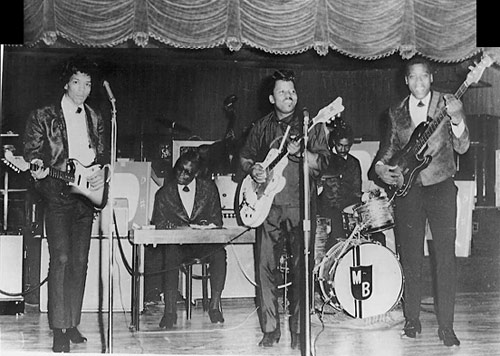
Continue ReadingDuring the latter part of the Isley Brothers’ tour in late 1964 and the tour with Little Richard in early to mid-1965 Jimi was seen playing a sunburst Fender Jazzmaster. The guitar was also seen in one of Jimi’s earliest TV appearances, in May 1965.

Jimi playing a Fender Jazzmaster guitar in the backline of Buddy & Stacy doing “Shotgun” on the television show Night Train from 1965. Based on the guitar’s appearance, we can narrow down its manufacturing year to around 1959 to 1964. The pickguard seen on Jimi’s guitar became available on the Jazzmaster model in 1959, and the small headstock as well as the logo, are both from the pre-1964 era. Additionally, the guitar appears to have a veneer fretboard, which would decrease the year range to 1959 – 1962. Unfortunately, we don’t have any photos showing the fretboard from an angle that would allow us to make a conclusive determination. If you happen to come across a photo of Jimi playing the Jazzmaster with a good angle on the top of the fretboard, please leave it in the comments.
319641950s/60s Fender Duo-Sonic (Sunburst)
Continue Reading 1965Jimi was seen playing this guitar during a few gigs that he did with Curtis Knight in late 1965/early 1966. Interestingly, this guitar was apparently a gift from Knight, as noted in Michael Heatley’s book “Jimi Hendrix Gear” on page 48.

Jimi Hendrix playing a sunburst Fender Duo-Sonic guitar in 1966. Unfortunately, there isn’t much information available about this guitar after Jimi’s time with Knight. It is likely that Jimi pawned the Duo-Sonic sometime before he left for London in late 1966 since the only guitar he carried with him to the UK was a white Stratocaster.
If you happen to have any information about this guitar, be sure to leave a comment below. Jimi Hendrix’s guitar collection is a fascinating topic, and any additional details are sure to add to the conversation.
1960s Fender Jazzmaster
Continue ReadingJimi was seen playing this guitar during a gig with King Curtis & the Kingpins in May 1966. Given that this is the only time he was ever seen with it, it is possible that the guitar was borrowed. To further point out that that could be the case, note that the strap button was not moved to the bottom as it would be if the Jazzmaster was converted permanently to left-handed playing.

King Curtis, Percy Sledge, Cornell Dupree, and Jimi Hendrix – Prelude Club NYC May 5th, 1966. Photo credit: William “PoPsie” Randolph. Prints are available at www.popsiephotos.com There are a few things to point out about the guitar, based on the photos available. It was likely made before mid-1965, as Fender started adding white binding around the neck on models made in late 1965. Additionally, the guitar seems to have the (at that time) new knobs, which were fitted on Jazzmasters from around mid-1965. [GuitarHQ – The Fender Jazzmaster]
While we don’t know for sure if Jimi owned this guitar, it’s clear that he was drawn to the Jazzmaster model in these early years, and his impact on the instrument’s popularity is undeniable. Whether borrowed or owned, this guitar is yet another piece of the Jimi Hendrix guitar legacy that continues to fascinate and inspire musicians and fans alike.
219661960s Fender Stratocaster (Carol)
Continue ReadingThis is likely one of the first, if not the first, Stratocasters that Hendrix ever owned. The history behind this guitar is however far from established.
In the book “Jimi Hendrix Gear” [p.62], it is noted that Jimi acquired this guitar at Manny’s Music shop in New York, and that his girlfriend at the time, Carol Shiroky, bought it for him. However, in Steven Roby’s book “Becoming Jimi Hendrix”, it is mentioned that Jimi broke the guitar after breaking up with Carol. [p.170]
Both stories are second-hand accounts and cannot be proven at this time. However, it is believed that this guitar was used for a very brief time in New York and was not the one Jimi carried with him to the UK in late 1966.
319661964 Fender Stratocaster (Linda)
Continue ReadingFrom the available photographs and testimonies of those who were present, it appears that Jimi Hendrix only brought a single guitar with him on his flight to the UK in September 1966. As he had not obtained a work permit in advance, it is believed that someone else, possibly Chas Chandler, brought the guitar on his behalf.
The guitar in question was reportedly a 1964 Fender Stratocaster with an Olympic White finish, which some sources speculate may have originally belonged to another guitar legend.

This photo was taken on February 1st, 1967, in New Cellar Club in Thomas Street, South Shields. Note the transition style logo and the fact that the guitar had become quite worn out by this time. The scratch on the top horn particularly is something to keep an eye out for when trying to identify this guitar in other photos. Photo by: Freddie Mudditt of Fietscher Fotos Ltd 1619661960s Fender Stratocaster (black, Darlington)
Continue ReadingStories of stolen guitars belonging to Jimi Hendrix are a common occurrence. According to some sources, Hendrix played a black Fender Stratocaster on the night of February 2nd, 1967, at the Imperial Hotel in Darlington, County Durham, which was stolen right after the gig.
An article in The Northern Echo reported that the guitar was at some point sold to a musician named Tony Carrington for $20, who then sold it to someone else as it apparently played quite badly, and he didn’t find it usable [‘I bought missing Jimi Hendrix guitar for £20’ – The Northern Echo].
Although it’s mentioned that possibly a few of his guitars were stolen that same night, someone is quoted later in the article linked above, saying that only a black Stratocaster had gone missing. It is also mentioned that Jimi didn’t particularly care about the black Strat, as he was mainly worried about a white one.
This white guitar that Hendrix cared about was most likely the 1964 Fender Stratocaster he carried with him from the US, the one given to him by. Linda Keith.
119671960s Fender Stratocaster
Continue ReadingThis 1960s Fender Stratocaster guitar was first spotted in a photograph taken on February 10th, 1967, at Bristol Locarno. However, none of the photos of the guitar show the headstock, so it’s impossible to identify which year it was made (an update on this is available in the comments section below).
Interestingly, Hendrix played a different white Stratocaster on stage that night, which suggests that the newly discovered guitar may have been a backup or a replacement for a lost or stolen instrument. In fact, it’s rumored that Hendrix’s black Stratocaster was stolen on the night of February 2nd, so this guitar may have been brought in as a replacement.
However, it’s worth noting that Hendrix later switched to using two sunburst Stratocasters in March 1967, and this white guitar was nowhere to be seen. There are two possible explanations for this: either the guitar was kept safe at Hendrix’s house and brought out for specific performances, or it was stolen or lost between mid-February and early March.
219671963 Fender Stratocaster (Sunburst)
Continue ReadingHendrix was seen using this sunburst Fender Stratocaster starting in late February 1967. Based on what can be concluded from photos and research on his other guitars, it is likely that Hendrix bought this guitar upon returning to London after a short North East tour during which a couple of his guitars went missing.
One of the first gigs that Hendrix did with the sunburst Stratocaster was in Chelmsford on February 25th. Fortunately, a video recording of this gig is still available, although the footage is pretty low quality.

Jimi playing his 1963 Fender Stratocaster in Chelmsford on February 25th, 1967. Another sunburst Stratocaster is seen sitting on the stage behind him. As you might’ve noticed from the photo above, there was another sunburst Stratocaster sitting on the stage. At this point, it is suspected that this is the same guitar that Jimi burned at The Astoria on March 1st, 1967.
2019671965 Fender Stratocaster (Astoria Strat)
Continue Reading 1967This is the guitar that Jimi allegedly set on fire at the gig played in The Astoria, London, England, on March 31, 1967. The gig was the first concert of the Walkers Brothers tour, which also featured Cat Stevens and Engelbert Humperdinck.
Unfortunately, not much of the guitar’s history is known. As we discussed in the article about Jimi’s 1963 Fender Stratocaster (Sunburst), he had at least two sunburst Stratocasters in mid-March 1967. The first guitar is the 1963 Strat, while the second one seemed to have been a sort of a backup/disposable guitar, to which Hendrix switched for stunts at the end of the set. Based on photos (explained a few paragraphs below) the alleged Astoria Strat is neither of the two and to our knowledge, no one was successful in finding a photo of Jimi actually using it. This is troubling considering the fact that it was sold in 2008 and dubbed the Astoria Stratocaster – the first guitar that Jimi ever set on fire.
This guitar was put for an auction in 2008, after being kept for more than 40 years by the band’s press officer, Anthony (Tony) Garland. [Scorched Jimi Hendrix guitar sold on Auction – Telegraph] It was sold for £280,000 – which translates to roughly $575,000, to an American collector Daniel Boucher.
196? Fender Stratocaster (Zappa)
Continue ReadingThis Stratocaster was given to Frank Zappa by Howard Parker – Hendrix’s roadie, at the 1968 Miami Pop Festival. The history of the guitar is however far from established, and some even doubt its legitimacy since until just recently there’s been proof of Jimi only ever burning two guitars in his life – both of which are accounted for.

Frank Zappa on the cover of Guitar Player magazine with Jimi’s scorched guitar. Well, there was this guy named Howard Parker – they called him ‘H’ – who was Hendrix’s roadie, gofer and general assistant. He stayed at our house for a couple of months in the late ’60s, and he had this guitar which Hendrix had given to him – I thought it was from the Miami concert.
The guitar now belongs to Frank’s son Dweezil Zappa, who revealed a bit of the history behind it in an interview with Normans Rare Guitars.
819671963/64 Fender Stratocaster (Monterey Pop)
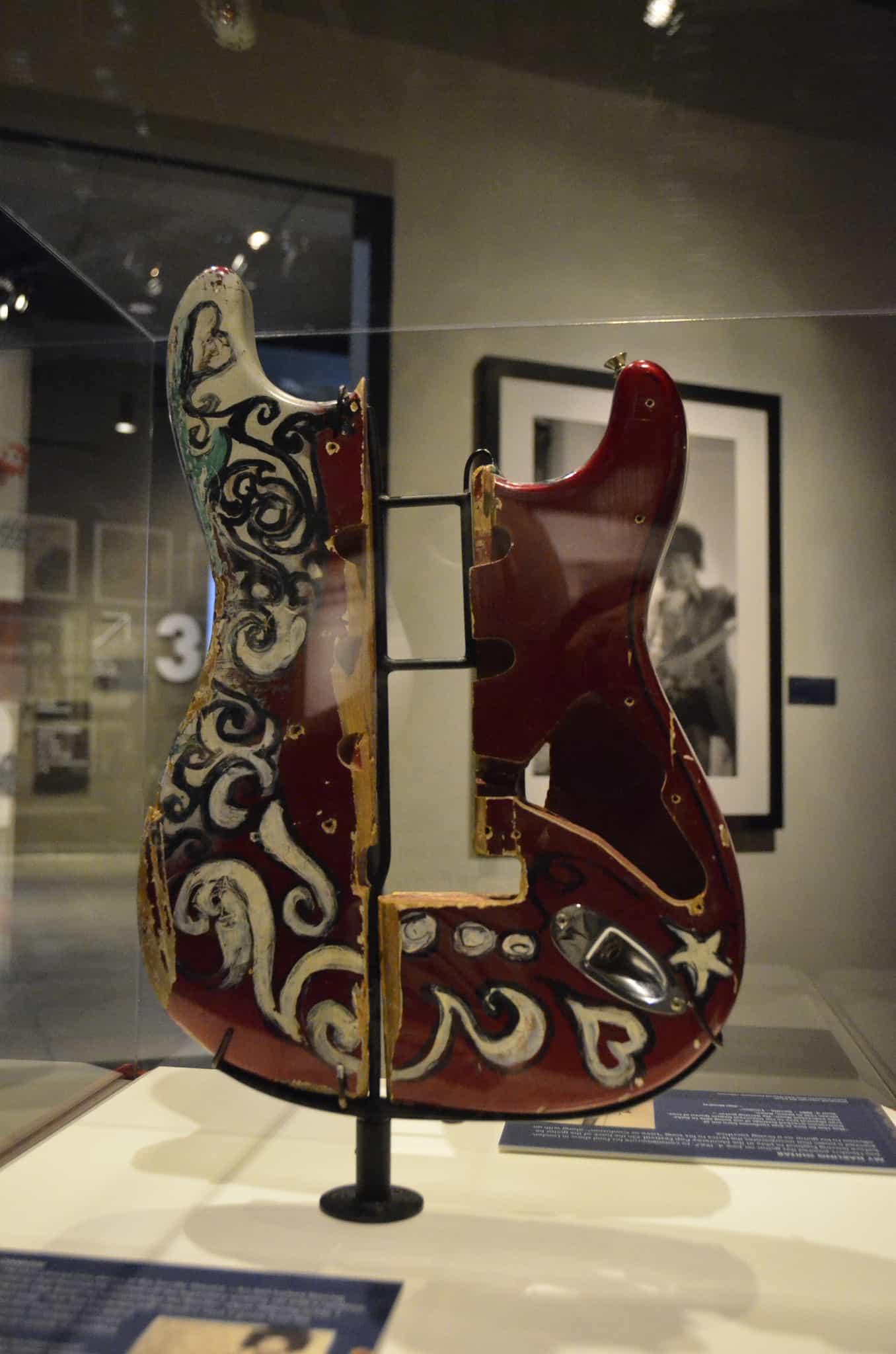
Continue ReadingThis guitar was first used by Jimi sometime in March 1967, likely on the 30th when the band appeared on the Top of the Pops TV program. All the photos from that day are black and white, unfortunately, so it’s hard to tell the exact color of the body, but it did seem to be finished in a solid color. Likely, it was red, since that would make the most sense based on later photos.
Also, this seemed to have been the only red Strat with a rosewood fretboard that Jimi ever played, and it perfectly matches the Monterey Strat specs, aside of course, from the hand-drawn design. As far as these things go, it’s pretty much a sure thing that this is the guitar that Jimi burned at the Monterey Pop Festival.

Jimi Hendrix at the amusement park Gröna Lund in Stockholm, Sweden, May 24, 1967. 1219671960s Fender Stratocaster (Saville Theater / Sgt. Pepper's Strat)
Continue ReadingThis is the second of the two red Fender Stratocasters that Jimi used around May 1967. Based on the photos available, it was likely first used at Saville Theatre on May 7th (this is an earlier gig played at Saville, it’s not the one during which he smashed the guitar), but it is possible that it was used at an earlier date.

The Saville / Sgt. Pepper’s Stratocaster after Jimi smashed it at Saville Theater on June 4th, 1967. Photo credit: Jason Camhi/Flickr This red Strat was mainly played just during the short European tour in May 1967. By the end of the tour, it developed a crack across the body, from Hendrix smashing it at a gig in Copenhagen on May 21st.
I was playing in Copenhagen, and I got pulled off stage. Everything was going great. I threw my guitar back onto the stage and jumped back after it. When I picked it up there was a great crack down the middle. I just lost my temper and smashed the damn thing to pieces.
Starting at Zero: His Own Story – Jimi Hendrix
1119671965 Fender Jaguar (Black)
Continue ReadingAccording to Tappy Wright, Jimi’s roadie, this guitar (Serial Number: L65163) was given to Hendrix by Brian Jones of the Rolling Stones just before the Monterey gig on June 8, 1967.
When I flew across from London to Monterey to bring Jimi over, Brian Jones came with us, as did one of the Animals. As we got there, Jones had the guitar with him and then gave Jimi that Jaguar guitar. […] It’s still in good condition. After Jimi left the guitar with me, I kept the guitar in the main office, so I had it re-strung. It was almost mandatory that you had a guitar lying around the office for the Rock n-Roll junkies. They automatically would pick up the guitar and start playing it. Hilton Valentine, Soft Machine, and other Rock Stars strummed this Fender.
From Tappy Wright’s letter of authenticity
Based on the information given by Tappy, Jimi couldn’t use the guitar right away because it was strung up right-handed. Tappy re-strung it lefty after returning to London, and Jimi used it at Olympic Studios in Barnes, England, sometime in October 1967, to cut Experiencing the Blues and Houndog.
219671965/66 Fender Stratocaster (Black, Monterey)
Continue ReadingIf one was to rank guitars in order of their usage during the some of the most iconic performances of Jimi’s, this black Stratocaster would probably be way up there at least in the top three.
It was first used (probably) at the Monterey Pop Festival on June 18, 1967. During this gig, Hendrix played the guitar on Killing Floor, Foxy Lady, Dylan’s Like A Rolling Stone, Rock Me Baby, Hey Joe, Can You See Me, and The Wind Cries Mary. At the end of the concert, he switched to a red Stratocaster painted by himself, and then set that guitar on fire after playing a cover of The Troggs’ Wild Thing.

Hendrix with the black Strat at the Monterey Pop Festival. Source: YouTube Screencap Please note that the section that was previously here – which was about some of the weird details on the guitar, like the placement of the logo – is now removed. The reason for this is that the section was completely based on the alleged Stratocaster that appeared on auction recently, and was proven to be a fake. Thanks Daze in the comments for clearing up the whole thing regarding this.
719671967 Fender Stratocaster (White)
Continue ReadingJimi started using this guitar upon returning to the US, in July 1967. It was seen on July 2nd at Whisky A Go-Go, and a few days later on the 5th at the Rheingold Central Park Music Festival. From then on it was used on nearly all (probably all of them at least to some extent, but no way to tell for sure) of the US gigs up until Jimi’s return to the UK on August 20th.
Back in the UK, Hendrix continued using this Strat as his main go-to guitar. Among others, it was seen at the Hollywood Bowl, on Aug 18th, at the Olympic Studios in October 1967 [Jimi Hendrix and Noel Redding in a London recording studio, October 1967], and at the Vitus TV Studios, Bussum for the recording of the television show “Hoepla” on November 10th.

Jimi Hendrix performs for the Dutch television show Hoepla, on November 10, 1967. 119671967 Gibson Flying V (Hand-painted)
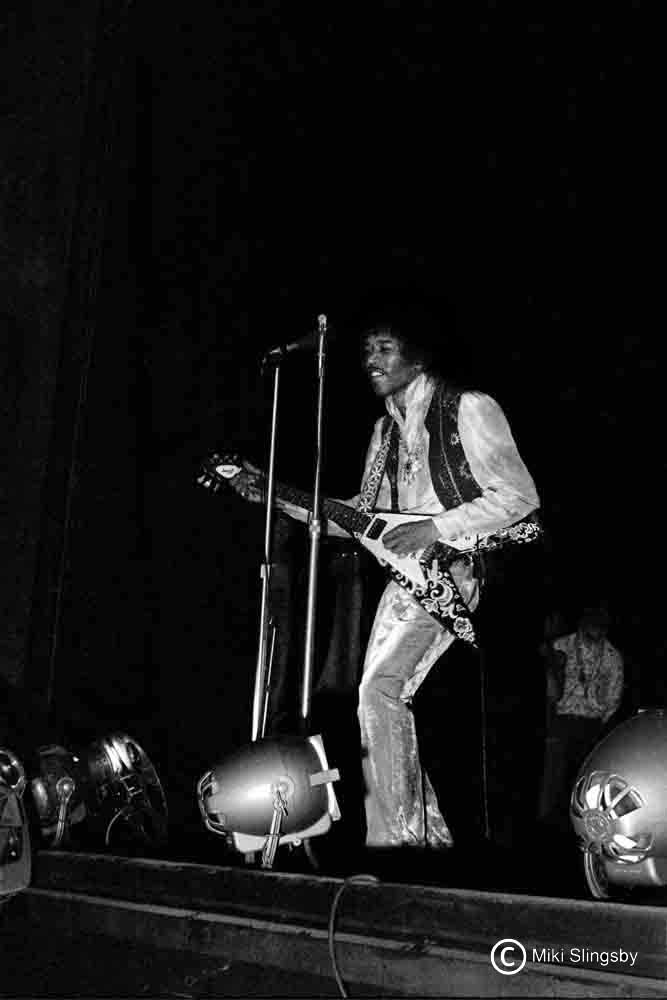
Continue ReadingThe earliest photo of Jimi playing this guitar on stage seems to date to around July 1967. This was at the beginning of The Monkees tour, so possibly at Miami Beach on July 8, 1967.
Based on this, it is likely that Jimi purchased it in the US – perhaps in early July when he was staying in New York (Manny’s Music Shop in NYC was a very popular guitar store among rock stars back then).

Jimi Hendrix with the custom-painted Gibson Flying V at the Saville Theater on October 8, 1967. Photo credit: Miki Slingsby. Available for print at: hagsphotography.com From late August 1967, and Jimi’s return to the UK, the Gibson became one of his main go-to guitars. It was seen on numerous occasions either being used or sitting on stage while Jimi was playing his white Stratocaster.
819671960s Fender Stratocaster (Tortoiseshell)
Continue Reading 1967This, for the time – unusual, Strat was used around late 1967. It was first seen at the Hollywood Bowl in Los Angeles on August 18, 1967. Less than ten days later, the guitar was seen once again at the Saville Theater in London.
From then on it was played on a few more occasions, but not nearly as much as Jimi’s main white Strat with white pickguard. This guitar seemed to have been something Jimi would use mainly at the end of the set, for his usual routine of smashing it against a Marshall stack. An example of this can be seen at the Blackpool Opera House on November 25, 1967 – which is also likely the last time this guitar appeared on stage.

Jimi Hendrix playing a white Fender Stratocaster with a tortoiseshell pickguard on stage at the at the Blackpool Opera House on November 25, 1967. 1960s Fender Jaguar (Blue)
Continue ReadingThere are a few photos of Jimi playing a Fender Jaguar (see comments) in what’s either a dark blue or black finish. It seems that all of the photos were taken on the same day, August 24, 1967, at the Lime Grove Studios for the Top Of The Pops TV show.
The most interesting thing about the guitar is that it was strung for a right-handed player, meaning that it probably didn’t belong to Jimi but was borrowed just for that occasion. Beyond that, the guitar is a mystery. If you happen to come across any mention of it by Jimi or someone close to him, be sure to leave a comment.
21967Mosrite Joe Maphis 12/6 Doubleneck
Continue ReadingThis guitar was shown at the EMP (now MoPOP) museum in Seattle during a special Hendrix event. According to the museum’s info, Jimi purchased it at Manny’s Music shop in New York and used it for the recording of Spanish Castle Magic from the Axis: Bold as Love (1967) album.
As far as the specs, the guitar, obviously, has two necks – one with six strings, and the other with twelve. The pickups in it (if original) are single-coils, which usually measure up to 13K in output, which is very high compared to Fender pickups which measured around 6k Ohms on the models made in the early 60s.

Jimi Hendrix’s Mosrite Double-neck photographed at EMP/MoPOP 719671960s Fender Stratocaster (Modified)
Continue ReadingJimi was seen using this guitar only on a few occasions, most notably at rehearsals at The Saville Theatre, London on October 8, 1967, at L’Olympia, Paris on October 9, 1967, and in Gothenburg on January 4, 1968.
It is an odd guitar in the sense that it’s the only heavily modified Stratocaster that Hendrix ever was seen playing. Also, if we assume that Hendrix modified the guitar himself, or more precisely had someone modify it for him for some specific reason (something he didn’t like on a standard Strat for example), it would make sense that he would want to keep on using the guitar, but for some reason, he chose not to.
It is also possible that someone wired a separate pickguard and handed it to him, Jimi tried it out in one of his guitars, ended up not liking it, and forgot about the whole thing.
119671967 Fender Stratocaster (White)
Continue ReadingThis is the guitar that Jimi switched to from his first 1967 Strat. This second Strat first saw stage light on February 2, 1968, in San Francisco, US. [Jimi Hendrix, backstage at Winterland Ballroom, San Francisco, 1968 – Time] In essence, the two guitars were identical, aside from the wear on the old one that by February 1968 became quite extensive (especially around the upper horn of the body). The new guitar did, however, have a small cigarette burn on the headstock, which means that it was probably used even before February.
He used this white Strat for most of 1968, and likely all the way up until the TTG Studio sessions in mid-October that year. Although photos are somewhat scarce, it seems that guitar was played on almost all gigs between February and October, assuming that it was indeed one same guitar and not a few identical ones. Last photos of Hendrix playing this particular guitar that seems to date back to around late October 1968.
Most notable gigs played on this white 1967 Stratocaster include The Fillmore East on May 10th [Jimi Hendrix performing at the Fillmore East (Photo by Frank Mastropolo/Corbis via Getty Images)] and Miami Pop Festival on May 18th (for a full list of gigs and your own research visit JIMI HENDRIX TIMELINE September 1966 – September 1970). The Miami Pop Strat does not, however, have the cigarette burn on the headstock, so it is possible that that was a different guitar.

Jimi Hendrix, Miami Pop 1968. Note the two sunburst Strats in the back – both of these are currently not on this list. 61968Fender Stratocaster (Red, Masonic Temple)
Continue ReadingJimi was seen using this guitar at the Masonic Temple in Detroit on February 13, 1968. At that point, the guitar already had a broken headstock, which would indicate that it was used prior.
However, no other photos of Jimi with the guitar exist, so it’s hard to tell for sure when exactly he did the damage to the headstock. He played a total of four shows at Electric Factory Philadelphia on the 22nd and 23rd, so it’s possible that the damage happened here.
What can be concluded from the photos taken at the Masonic Temple, is that this was a rosewood fretboard Strat, with some sort of a dark red color finish. Certainly darker than Fiesta Red, so it was possibly the Dakota Red.
219681965 Fender Jazzmaster (Sunburst)
Continue ReadingBased on photographic evidence, this guitar was only used on a few gigs in March/April 1968. It was first seen at the University Of Toledo Fieldhouse on March 30th [Toledo (University Of Toledo Fieldhouse) : 30 mars 1968], and last on April 5th at the Symphony Hall in Newark [Newark (Symphony Hall) : 5 avril 1968].
The guitar was also possibly used at the Miami Festival on May 18th, as it was seen sitting behind Jimi, together with a sunburst Strat (thanks kumanovce in the comments).

The Jaguar on stage at the Miami Pop Festival. 419681956 Gibson Les Paul Custom (Fillmore West, Miami Pop)
Continue ReadingJimi started using this guitar around April 1968. The earliest photos date to April 5th, 1968 [Newark (Symphony Hall) : 5 avril 1968], which could possibly mean that this is something Jimi acquired at Manny’s Music shop, which is just a 30-minute drive from the Symphony Hall. At that time, the guitar seemed the have been used exclusively on the song Red House, and it seemed to have some sort of a white sticker on the top of the body.
The Les Paul was however most famously used at Bill Graham’s Fillmore East venue in New York on May 10, 1968 [Jimi Hendrix performing at the Fillmore East (Photo by Frank Mastropolo/Corbis via Getty Images)], and at the Miami Pop Festival on May 18th. Aside from these two, Hendrix apparently hasn’t really played the guitar that much, since it was spotted during only a handful of gigs around this period.
The guitar is currently owned by the Hard Rock Café International and can be seen at their restaurant in Chicago on 63 West Ontario St. According to the info posted on their website, the guitar was produced in 1956. At this time, we have contacted their memorabilia staff about more info on the guitar, but have yet to receive a response.
119681967 Guild Starfire V
Continue ReadingThis guitar was used only once by Jimi, on May 19, 1968, at the Wreck Bar within the Castaways Hotel, in Sunny Isles Beach, Florida, after the Miami Pop Festival.
The Miami Pop Festival was originally scheduled as a two-day event, but the second day was canceled due to a thunderstorm, which prompted the performers to gather in the Castaways Hotel to take refuge from the rain and start a jam session.
There’s is only one photograph from that night of Jimi using this guitar [Jimi Hendrix’s 1967 Electric Guild Starfire V – liveauctioneers.com] It is unknown whether Jimi had the guitar with him prior to this, or whether it was something he acquired that night. Also, the story behind the stickers covering the front of the guitar is a mystery.
Be that as it may, the Guild somehow ended up with Jimi’s father, Al, with whom it remained until his death in 2002. After that, we’re guessing it remained within the family until 2017 when it was put up for auction. The starting bid was $140,000.
219681950s Gibson Les Paul TV Special
Continue ReadingJimi was seen using this guitar on two occasions, one on May 31, 1968, at the Hallenstadion, Zurich. [‘Monster-Konzert’, Hallenstadion, Zurich. (30/05/1968)], and the other during the studio sessions for South Saturn Delta [Horn players on Hendrix’ South Saturn Delta]. Based on the photos, the guitar is a mid-50s Les Paul Special with two pickups, finished in what’s commonly known as TV yellow.
If you happen to know anything else about the guitar, please be sure to leave a comment below.
219681967/68 Fender Stratocaster (Blue)
Continue ReadingThis guitar is not all that significant at least when compared to some of the others, but it is nonetheless one of the more interesting ones. Jimi used it for a very brief period of time, most likely not much longer than a few months.
It was first seen in Zurich, Switzerland at the Monsterkonzert on May 31st of 1968 [see comments below, thanks Chad], and then again, in pieces, at the Lagoon Opera House, Salt Lake City on August 30, 1968.
Interestingly, Jimi or someone close to him, re-assembled the guitar and Jimi continued using it with half a headstock (the functioning half). It was seen in this state in Seattle on September 4, 1968 (thanks Scott).
But, perhaps the most interesting thing about this guitar is actually the color.
1019681967 Fender Stratocaster (Sunburst)
Continue Reading 1968Jimi was seen playing this guitar in a photo taken of him at the TTG Studios in October 1968. Most of the photos taken during these TTG sessions show him playing his black 1968 Strat, but there’s at least one that shows him playing a large-headstock sunburst Stratocaster.

Jimi Hendrix playing a sunburst Stratocaster at the TTG Studios, October 1968. A guitar that was dubbed “the TTG Stratocaster” was seen on various auctions online from around 2021. It was at one point even available for purchase on Reverb.com, where it was listed by someone named “Neil’s Gear Bazaar”.
Acoustic/Bartell "The Black Widow"
Continue Reading 1968Jimi acquired this guitar in October 1968. As the story goes, Harvey Gerst, a rep from Acoustic Control Corporation, came to help Jimi in TTG Studios LA with four Acoustic amps that Jimi purchased.
I got a call on Saturday morning from steve Marks, the president of Acoustic, saying, “go down to TGG right now!” Why? “Jimi Hendrix just bought four of our amps and he’s having trouble with some of the controls.
Harvey Gerst – Tape Op Magazine
Before we talk about the guitar, we should talk a little about the company behind it. Acoustic Control Corporation up until the early 70s focused on making solid-state guitar amps. Their first official electric guitar, the Black Widow, became available in 1972.
1967/68 Fender Stratocaster (Black)
Continue Reading 1968Jimi was seen with this guitar in a number of photos taken of him by Ron Raffaelli in Hawaii on October 6th and 7th, 1968. As far as one can tell from the footage and the photos available, he did not use the guitar at the Honolulu International Center concert – it was only seen in the photos taken the day after the concert.
The guitar appears to be a large headstock model, which would mean that it was made probably in 1967 or 1968.
For whatever reason, Jimi was never really seen playing this guitar at any of the concerts after he came back from Hawaii either, so it is suspected that he either left the guitar there or that he gave it to somebody. It’s also possible that the guitar wasn’t his, but this is less likely.
1968 Fender Stratocaster "Black Beauty"
Continue ReadingHendrix started using this guitar in mid-October 1968, and it represented a shift away from rosewood and towards maple fretboard Stratocasters. Up until this point, almost every guitar that he played had a rosewood fretboard. This is understandable considering the fact that he mostly used early to mid 60s Strats, most of which were shipped with rosewood fretboards, at least up until around mid-1965.
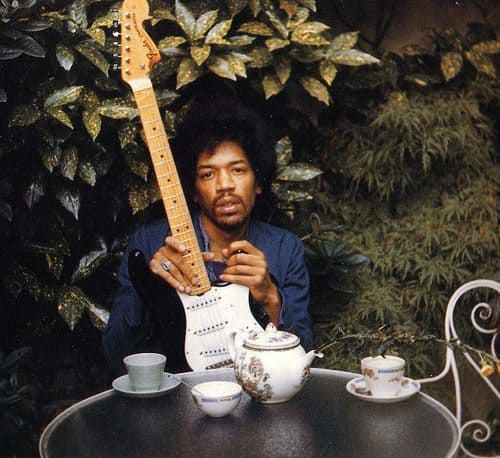
The guitar was one of the two maple neck Stratocasters that Jimi started using around this time – the other one being almost an identical guitar but finished in white. While we’re still researching the possibility of there being two white Strats, there was most likely only one black Stratocaster with a maple neck. This guitar was not only used throughout 1969 but also in 1970 – up until Jimi’s death. In fact, the very last known photos of Jimi show him holding this exact guitar.

One of the last photographs of Hendrix taken by Monika Dannemann at the Samarkand Hotel, on September 17, 1970 – the day before his death. He is seen holding the black Strat, which many assume was his favorite. The guitar was first seen on stage at the Civic Auditorium in Bakersfield, California on October 26, 1968. [Hendrix concert in Bakersfield the stuff of legend -bakersfield.com] This was right in between the recording sessions at the TTG Studios in Los Angeles, and based on the photos taken by Ron Raffaelli at the studios, the guitar was used there as well (photos should be fairly easy to find with a quick Google search).
2419681968 Fender Stratocaster (Woodstock)
Continue ReadingThis is probably the best-known guitar of Jimi’s. It was used at the Woodstock Festival on August 18, 1969. Before Woodstock however – things are somewhat unclear. It seems that the guitar was used from around the same time as Jimi’s black Strat, around October 1968, but have gone out of rotation sometime in 1969 in favor of a different white Strat that looked nearly identical.

Jimi Hendrix with his white Fender Stratocaster at Woodstock The Woodstock Strat was used probably from late October or early November 1968. Based on the photos available, The Bakersfield Civic Auditorium on October 26th was played on the black Strat and one of the older white Strat with a rosewood fretboard, while the next concert on November 1st at the Municipal Auditorium Arena in Kansas featured a white Strat with a maple neck.
One is inclined to assume that this is the Woodstock Strat, although there’s no actual way to prove it. As is often the case with Jimi’s guitars, the only option is to speculate.
5019681967 Gibson SG Custom
Continue ReadingThis 1967 Gibson SG Custom is most famous for its appearance on the Dick Cavett show on September 9, 1969. The guitar was however first seen in Jimi’s hands around late 1968. More precisely, on November 27, 1968, Rhode Island Auditorium gig seem to be the first one to feature this guitar based on the photos.

Jimi playing his ’67 Gibson SG Custom at the Dick Cavett Show. From then on the SG popped in occasionally, most likely to be used on tracks such as Red House which in the past he mostly played on humbucker-equipped guitars.
Also, in late 1968 and early 1969, Jimi often played Cream’s Sunshine of Your Love, which on some video recordings he played on the SG. Perhaps a nod to Eric who himself likely recorded the track on a Gibson SG (you can read a bit more about it in 1964 Gibson SG Standard ”The Fool”).
319681969 Gibson Flying V (Tobacco burst)
Continue Reading 1969This is chronologically the second Gibson Flying V that Jimi played in his career. Of the three that he had in total (or at least used publicly), this one is probably the least known and most certainly the least photographed. This, of course, makes it much more difficult to research this guitar properly.
Although some sources claim that Jimi started using the tobacco burst Flying V as early as January 1969, the first photo of Hendrix with the guitar seems to date to May 18, 1969, and was taken backstage at the Madison Square Garden [The not-so-slight return of Jimi Hendrix By Todd Leopold, CNN] Given the assumption that Jimi used the Flying V only for a song or two during a set, it is definitely possible that he used it prior to May 18th, but that it simply wasn’t photographed nor filmed.
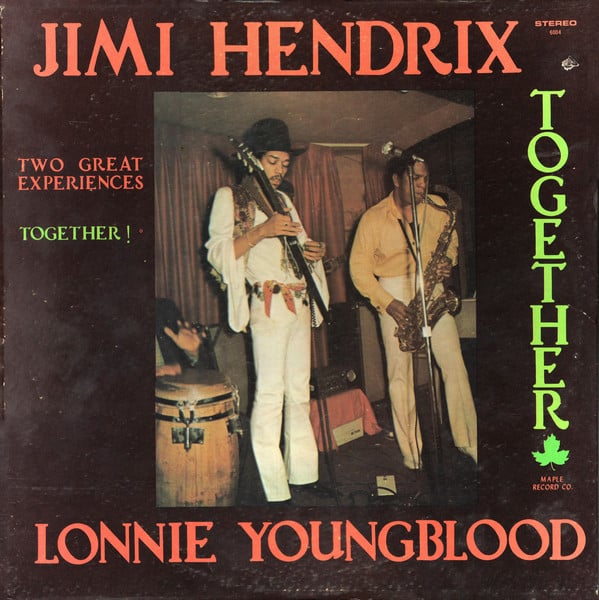
The second photo that shows Jimi with the guitar was featured on the cover of Lonnie Youngblood’s album Two Great Experiences Together (see below), which was taken sometime in 1969 (if you know of an exact date, leave a comment).

Jimi Hendrix And Lonnie Youngblood – Two Great Experiences – Together (1971) 1960s Fender Stratocaster (Telecaster neck, Newport)
Continue ReadingJimi used this guitar only two times, both at the Newport Pop Festival in June 1969. Based on the photos and footage available, the guitar was used on both June 20th and June 22nd.

Jimi playing a Stratocaster with a Telecaster neck at Newport Pop Festival. Screencap YouTube. The guitar is one of the weird ones, in a sense that it was without a doubt put together using parts from at least two different guitars. The neck is from a late 1960s Telecaster, while the body is from a Stratocaster.
The question is whether any of the parts belonged to one of Jimi’s old guitars, or whether there they were picked up from a guitar store/shop. The chance is that at least the body came from one of Jimi’s white Strats.
919691968 Fender Stratocaster (black, left-handed)
Continue Reading 1969Jimi Hendrix bought this left-handed black 1968 Stratocaster with a maple neck at Manny’s Music in New York City and gave it as a present to Richard “Deering” Howe. Howe was a friend of Jimi’s in the late 60s, and apparently, the two traveled to Morocco together in the summer of 1969.
The guitar remained with Howe until 1988 when he decided to sell it through Sotheby’s auction house. Unfortunately, no information about this auction is available online, so we don’t know how much the guitar sold, and with whom it ended up. If you happen to have information about this, please be sure to leave a comment below.
Jimi mainly used restrung right-handed guitars, but he did own a black, maple neck 1968 left-handed Stratocaster. This instrument was sold at Sotheby’s in 1988.
Douglas J Noble, Music Director of UniVibes, the international Jimi Hendrix magazine
Deering Howe was also friends with Duane Allman. Howe owned or rented a penthouse at One-Fifth Avenue, and during one of his visits to New York City, Duane played this guitar which was strung right-handed (Gregg Allman, My Cross to Bear, p. 185 – 186).
1955 Gibson Les Paul Custom
Continue Reading 1969According to Larry Lee, this guitar was purchased by him and Hendrix in 1963 when they played in a band called Bob Fisher and the Bonnevilles. When Larry was invited to join Gypsy Sun and the Rainbows in 1969, a week prior to Woodstock, Hendrix allegedly gave it to him since he had no instrument of his – being just recently released from the army.
All this is based on the info provided by the EMP Museum (recently renamed to Museum of Pop Culture) in Seattle, the current owners of the guitar. It is assumed that the info has been originally provided to them by Larry Lee, who sold the guitar through Sotheby’s in 1991.
The interesting thing to point out about this guitar is that it has a Bigsby tailpiece and a replaced neck pickup. The original pickup on a ’55 Les Paul Custom, the Alnico V, has staple pole pieces, while the pickup in Jimi’s/Larry’s Custom looked like a P90. This same type of pickup, of course, was fitted in the bridge position on these models. For photos visit this thread on MyLesPaul forums: Jimi Hendrix’s 1955 Les Paul Custom
1960s Gibson SG Custom (Red)
Continue ReadingIt seems that this guitar was used on one gig, at the Ungano’s club in New York in January 1970 [Jimi with Elvin Bishop – Unganos Club, New York City 1969/70] If you happen to come across any other photo of Hendrix with the guitar, please be sure to send it to us.
The guitar was allegedly a gift from the club owners since Jimi was apparently a frequent visitor and often jammed with other musicians in the club – such as Peter Green, BB King, and Jimmy Creed. This is based on a comment on an online blog about The Grateful Dead, written by a person who was once employed at the club.
Jimi jammed so many other times. We wound up buying him the left-handed white SG that is in some photos out there…Jimi was a regular and he loved the club.
February 12, 1970 Ungano’s, New York, NY 210 West 70th Street The Grateful Dead – LOST LIVE DEAD
The part about the guitar being a white SG is somewhat confusing, but based on the information that is available, Jimi didn’t have a left-handed SG finished in white. The person who made the comment likely confused this guitar with the other SG that Jimi was often seen playing in late 1968 and in 1969.
319701970 Gibson Flying V (Left-handed, Black)
Continue ReadingAlthough Jimi was no stranger to Flying Vs, this was the only one specifically made for him to be played left-handed.
The guitar was first seen on April 25, 1970, at the Los Angeles Forum, and subsequentially on May 8, 1970 at the University Of Oklahoma Field House, Norman [Norman (Field House, University Of Oklahoma) : 8 mai 1970 [Premier concert]] From then on it was used a number of times until Jimi’s death, most famously, of course, at The Isle Of Wight on August 30th.

Jimi Hendrix at Isle of Wight Festival, August 31, 1970. Photo source: YouTube 319701970 Fender Stratocaster (sunburst, maple)
Continue ReadingThis guitar was purchased by Jimi on July 14, 1970, at Manny’s Music store in New York. Around that time Jimi was spending a lot of time at the Electric Lady Studios, which at that time still wasn’t finished completely. When the studio was opened, on August 26, an opening party was held. According to Noel Redding, Jimi played this exact guitar – however, no photos of the gig exist. (refer to auction page for source)

Original receipt from Manny’s dating to July 1970, signed by Eugene McFadden, Hendrix road manager. On August 27th, Jimi flew to London, and most likely left the guitar at the Electric Lady Studios, since it was not seen at any of the gigs played between August 27th and Jimi’s passing on September 18th.
From that point, it’s not exactly clear what happened to the guitar and with whom it ended up. It was signed by Noel Redding at some point, apparently when it was first sold.
41970Jimi Hendrix's 1970s Fender Stratocaster (white, left-handed)
Continue Reading 1970Hendrix ordered two left-handed Stratocasters at Manny’s in NYC sometime in late 1969/early 1970 but failed to pick them up. One was black, the other one was white, and they both had rosewood fretboards.
The guitars were left at the store until Steve Miller bought them in the early 1970s through Henry Goldrich – the owner of Manny’s. The black Strat, which can be seen on the front picture on the record sleeve of the Fly Like an Eagle album, was at some point stolen from him.
I’ve known Henry since I was 20 years old and bought lots of guitars from Manny’s. He had two guitars that Hendrix ordered but never picked up. He said, “You can have them.” One was black, one was white.
So I took them, had them set up with the strings flipped, and recorded a lot with the white one, which I still have. It’s an amazing guitar, with a rosewood fretboard. I may have recorded “Fly Like An Eagle” with that guitar.
Steve Miller – Some People Call Him Rock Icon
1970s Fender Stratocaster (black, left-handed)
Continue Reading 1970Sometime in late 1969/early 1970, Hendrix ordered two left-handed Stratocasters at Manny’s in New York, but after his untimely death, they both remained at the store and were never picked up. One of the Strats was black, the other one was white, and they both had rosewood fretboards.
Both guitars were purchased in early 1970 by Steve Miller, who was a good friend of Henry Goldrich – the owner of Manny’s. Unfortunately, the black Strat was stolen from Steve at some point and never recovered.
I’ve known Henry since I was 20 years old and bought lots of guitars from Manny’s. He had two guitars that Hendrix ordered but never picked up. He said, “You can have them.” One was black, one was white.
So I took them, had them set up with the strings flipped, and recorded a lot with the white one, which I still have. It’s an amazing guitar, with a rosewood fretboard. I may have recorded “Fly Like An Eagle” with that guitar.

Steve Miller with the right-handed Hendrix Stratocaster on the cover of his album “Fly Like an Eagle”.












Jimi Hendrix's Acoustic Guitars
1951 Epiphone FT79
Continue ReadingThis Epiphone (serial number 62262) was purchased by Jimi in 1967 sometime during the JHE US tour, which was the band’s first away from Europe. According to Noel Redding, the guitar was bought second-hand in New York, for about $25, and was brought back to England. [Bonhams: Jimi Hendrix: An Epiphone FT 79 acoustic guitar, 1951]
According to the info posted on Bonham’s auction page, the Epiphone was used extensively by Jimi in London, and many of the arrangements for the new songs were written on it. According to Kathy Etchingham, he mostly used an acoustic when playing and practicing at home.
Jimi used it for almost everything he composed in this country, as he didn’t use an amp until the move to Brook Street, and in any case Chas would never have allowed it in case we disturbed the neighbors because we’d upset them in Montague Square and Chas didn’t want to be chucked out of a second flat. Jimi would pick up and then play the acoustic, then pick up a Strat and play that unplugged, listening to it without an amp. He constantly played it to work out riffs and song arrangements including his own version of Dylan’s “All Along The Watchtower”.
Kathy Etchingham – Bonhams: Jimi Hendrix: An Epiphone FT 79 acoustic guitar, 1951
There are very few photos of Jimi playing the guitar, which is, of course, understandable since it was used in a more private setting. There is however one video recording of him using the guitar in what appears to be a bedroom, probably filmed around 1969. In the said video, Jimi can be seen playing a cover of Elvis Presley’s Hound Dog to a group of friends.
219671960s Zemaitis 12-string
Continue ReadingOne of the rare professional video recordings of Jimi with an acoustic guitar shows him playing an unplugged version of the song “Hear My Train A’ Comin'” on a twelve-string guitar. The short footage is a part of the film called “See My Music Talking”, recorded on December 19th, 1967 at the Bruce Fleming’s studio, London.

A still form the 1973 documentary “Jimi Hendrix” showing Jimi playing a Zemaitis 12-string guitar. The guitar that Jimi played in the video was made by a guitar luthier called Antanus Casimere (Tony) Zemaitis, based in London, England. All of the vintage Zemaitis guitars were made by Tony himself, and many of the popular guitarists of that time were seen playing one – including Eric Clapton, Donovan, Ronnie Wood, and Keith Richards. After Tony’s death in 2002, the production of Zemaitis guitars was moved over to Japan.
Unfortunately, there doesn’t seem to be any info on what happened to the guitar after Jimi’s death. It does, however, seem to be still around, as there are photos of it on a website by David Brewis (now down for some reason).
141967Thornward Parlor Guitar
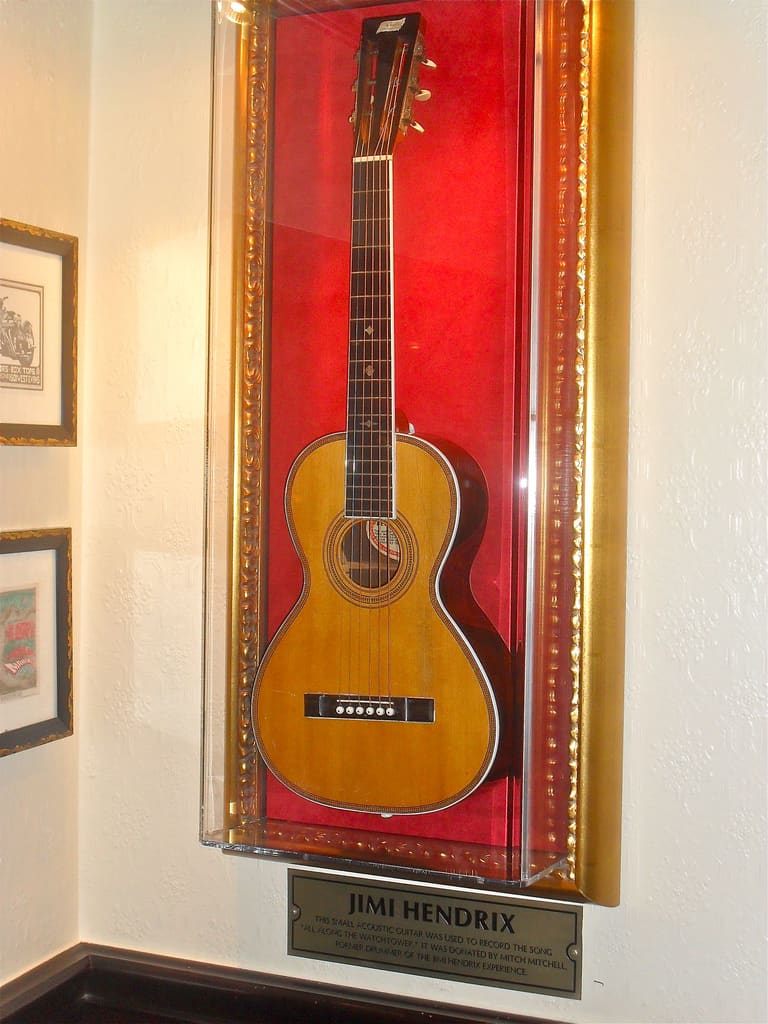
Continue Reading 1968All that is known about this guitar is that it is currently owned by Hard Rock Cafe International and that it can be seen at their restaurant in Amsterdam, Netherlands. According to the Hard Rock Cafe’s info, the guitar was donated to them by Mitch Michell, and it was used during the recording of All Along the Watchtower in 1968. Of course, Jimi was never photographed during the sessions, so there’s no way of confirming this.

Jimi’s parlor guitar at the Hard Rock Cafe in Amsterdam. Photo by: Mike Cattell/flickr As far as identifying the guitar, based to the paper label inside the guitar, this is likely something from the Washburn brand, made by Lyon & Healy from Chicago around the turn of the century (1900). The headstock label, however, reads “Thornward” (thanks Stephen from Vintage Parlor Guitars).
1968 Martin D-45
Continue Reading 1969Jimi bought this guitar in 1969 from Manny’s Music shop in New York. The guitar was passed on to Experience drummer Mitch Mitchell after Hendrix’s death, who kept it until 1992 when it was sold through auction.
It was purchased by Jimi in 1968 and kept at home to compose with. He wrote many things on it, including the “Black Guld Suite”. It did get taken to and used in studios in New York and can be heard on The Cry of Love album as well as other sessions.
Mitch Mitchell – letter from the 1992 auction – original source needed
Of course, nothing from this statement can be confirmed since Jimi was never photographed with the guitar, nor did he ever talk about it. But as far as reliable Hendrix sources go, Mitch Mitchell is probably as good as it comes. The statement does make sense, and it is highly likely that Jimi would pick up an acoustic to fool around in the US, similar to what he did with the Epiphone back in the UK.
In 1992 auction, the guitar was sold to Rock Star Guitars [Jimi Hendrix’s 1968 Martin D-45]. Shortly after, Jimi’s Martin was sold to the Experience Music Project in Seattle (or Museum of Pop Culture if we’re going by the more recent name) for an undisclosed sum.



Jimi Hendrix's Amps
Silvertone Twin Twelve
 Continue Reading 1963
Jimi seemed to have used this amp around late 1962 / early 1963. It can be seen on a photo of him performing with the King Kasuals. At the time of using this amp, Jimi played what is likely a 1961 Epiphone Wilshire.
Based on the book Starting at Zero: His Own Story, the amp was a gift from the owner of the club where the band was performing at that time.
In Clarksville we worked for a setup called W & W. Man, they paid us so little that we decided the two W’s stood for “Wicked and Wrong.” […] Then we got in with a club owner who seemed to like us a lot. He bought us some new gear. I had a Silvertone amp, and the others got Fender Bandmasters.
Starting at Zero: His Own Story

Jimi Hendrix with the King Kasuals, early 1963. Fender Twin Reverb
Continue ReadingJimi was seen using this amp in the pre-Experience days. More precisely, photos dating to his Curtis Knight days (late 1965/most of 1966) all seem to show Jimi playing through a Twin Reverb combo amp.

Jimi Hendrix with Curtis Knight and the Squiers. George’s Club 20, 1966. Photo credit: Unknown Given that he played the last gig with Curtis in August 1966, and left for the UK in September, it is likely that the amp was either sold prior to the UK trip, or it wasn’t Jimi’s to begin with. Because Jimi’s Twin Reverb wasn’t the only such amp on stage, it is likely that the amps were owned by the band, and that Jimi’s simply got to use it while playing with them.
21966Supro S6420 Thunderbolt
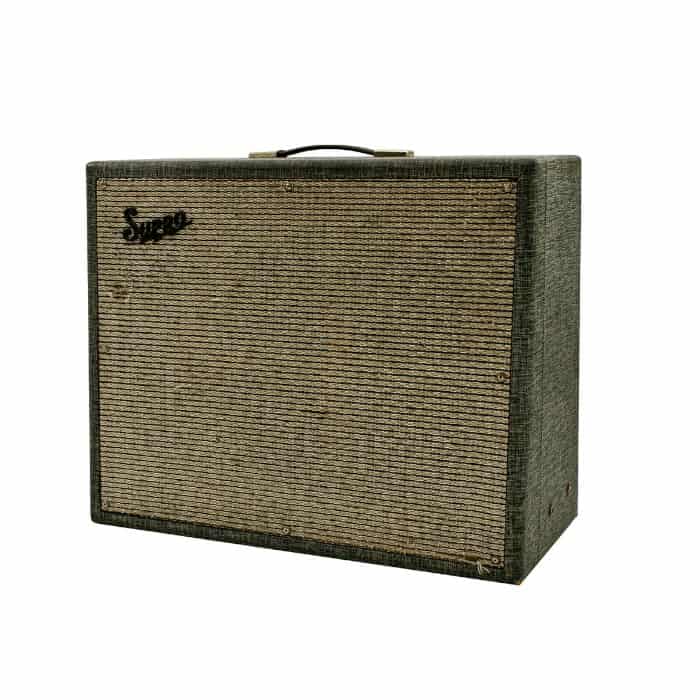
Continue ReadingAllegedly used in the early days with Curtis Knight, circa 1966. It is worth noting here that although some argue that an amp resembling a Supro Thunderbolt was seen on stage behind Jimi on at least one photo, it is very questionable if this actually holds any credibility. The whole theory seemed to have originated from someone’s statement, and then people tried retrospectively finding something that would resemble a Thunderbolt amp on a photo of Jimi.
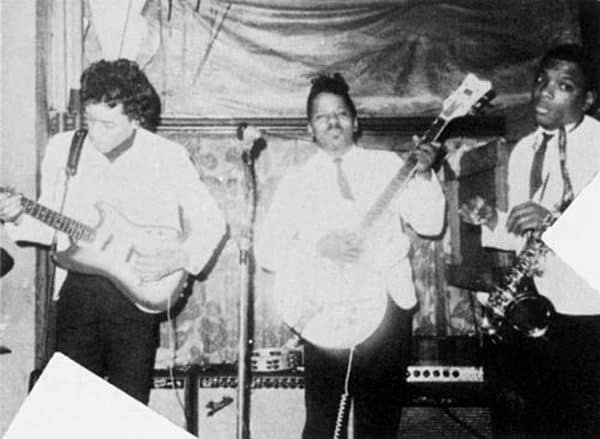
The problem with this theory, mainly, is that the amp that is on the left edge of the photo below, the one that Jimi’s guitar was likely plugged in and that one that people argue is a Supro amp, has metal corner guards, and controls on the front. Supro Thunderbolt is a very bland looking amp with no metal guards and controls located at the top. The amp on the photo below is more likely a Fender combo.

Jimi Hendrix with Curtis Knight and The Squiers. Some argue that he’s using the amp behind him on the left that seems to resemble a Supro Thunderbolt. Photo supplied by a visitor. 21966Marshall Super 100 JTM45/100
Continue Reading 1966Allegedly, Jimi first came across a Marshall amp, and tried one himself, while sitting in with Brian Auger’s band Trinity – most likely on September 28, 1966. According to Brian Auger, Jimi turned the amp all the way to 10 and instructed the band to follow him while he played “Hey Joe” – of course leaving everybody in the room (apparently including even Eric Clapton) completely stunned. [11-12-13 Brian Auger Talks of Jimi Hendrix, Marshall amps].
Following this, and Jimi’s discontent with Burns amps that the band was practicing on until then, on October 11, 1966, Jimi and Mitch Mitchell went out to meet Jim Marshall – the founder of Marshall Amplifiers. Apparently, Jim Marshall, who was a drummer himself, already knew Mitch – who had been a pupil of his at some point and had worked at Jim’s store.
On a Saturday afternoon in the autumn of ‘66, a tall, lanky American walked in with Johnny Mitchell—or “Mitch,” as most people knew him. Mitch used to work in my shop as a “Saturday boy,” and he was also one of my top drum students. The fellow who came in with him that day was James Marshall Hendrix, and he quickly became the greatest ambassador Marshall Amplifiers ever had.
I must admit, when Mitch introduced me to Jimi, I immediately thought, “Christ, here we go again—another American wanting something for nothing.” Thankfully, I was dead wrong. The very first thing Jimi said to me was, “I’ve got to use your stuff, but I don’t want anything given to me. I want to pay the full asking price.” That impressed me greatly, but then he added, “I am going to need service wherever I am in the world, though.” My initial reaction was, “Blimey, he’s going to expect me to put an engineer on a plane every time a valve needs replacing. It’s going to cost me a bloody fortune!” Instead, I suggested our staff teach Hendrix’s tech, Gerry Stickells, basic amp servicing skills, such as changing and biasing the valves. He must have been a very good learner, because we were never called on to sort out any problems.
Jim Marshall – original source needed
According to most sources, Jimi purchased two (some claim three) Marshall Super 100 heads, and four cabinets. He was first seen using the amps during the band’s short French tour, that began on October 13, 1966, concluded on October 18, 1966, and featured four shows. The first show on October 13 was also the first time that The Jimi Hendrix Experience ever performed together as a band. From this first tour, and until the end of his life, Jimi would continue using Marshall amps almost exclusively.
Guild Thunderbass Quantum Amp
Continue Reading 1967According to Dave Weyer, Jimi used this amp during his early days with The Jimi Hendrix Experience, and apparently later on as a preamp [Jimi Hendrix’s Wah-wah Pedal and Amp in J. Levine’s New Year’s Day Auction ] To which extent the amp was actually used is unfortunately unknown, but it is likely that it didn’t play a major role in Jimi sound.
The story of how the amp was discovered is pretty interesting. User by the name “tubezarmy” posted on the LetsTalkGuild.com forums that he bought a Thunderbass amp at a pawn shop, and discovered that it had “J H EXP” stenciled on the bottom. Apparently, the person then sent the amp to Weyer (who is known for working on Jimi equipment), who determined that this was the exact same amp that he modified for Jimi in the late 60s.
Detailed photos of this amp can be seen here – Guild amp – Jimi Hendrix.
Sound City One Hundred
Continue ReadingAccording to Roger Mayer (with whom one of our visitors had the chance to talk – see comments below), Jimi used a 1967 Sound City 100 Master Volume amp extensively on the Axis album.
Jimi used a single Sound City One Hundred amp (likely the same one from the Axis session) briefly during the latter part of the 1968 North American tour, from around mid-March to April/May (see Miami Pop photos). The amp seemed to have been used together with one of Jimi’s old Marshall JTM 45/100s.
31967Vox AC30
Continue Reading 1967According to Phil Brown, who was the audio engineer during the session, all of the overdubs on All Along the Watchtower were recorded on a Vox AC30
The setup for Hendrix’s electric guitar overdubs was achieved simply by placing a VOX AC30 amplifier in the studio, close to the control room window. We then placed Neumann U67s both close and distant, with an AKG C 12 A close to the amp. (Jimi) was hunched over the amp with his back to the control room window, his head bent low. We tried out numerous guitar ideas and sounds, desk distortion, fuzz box, wah-wah, Leslie cabinet, harmonizing, ADT, phasing, Pultec filtering, repeat echos and backwards effects.
Are We Still Rolling?, Phil Brown
1968 Fender Dual Showman
Continue ReadingIt seems that for a short period of time, around early 1968, Jimi used a few Fender Dual Showman amps for his live gigs. The amps were seen during the show at Fillmore East on February 1, 1968, on the 2nd at Winterland Ballroom, San Francisco, and lastly at Anaheim Convention Center, Anaheim on February 9, 1968. According to some sources, the amps were supplied by Fender for Jimi to use during the 1968 US tour.

Jimi Hendrix playing through a Fender Showman amp. However, during the Anaheim gig on February 2, 1968, a Marshall amp was seen on stage sitting below a Fender Dual Showman, apparently because the two Fenders broke and the band couldn’t finish the set. After the gig, Jimi struck a deal with Buck Munger of Sunn Amps and most likely got rid of the Fenders.
The amplifiers broke down during the first show, resulting in only four numbers being played during the second show. After the show Chas and Jimi were approached by Buck Munger representative for Sunn Amplification who replaced their Fender gear (provided at the start of the tour, but not powerful enough for Jimi’s tastes) with brand new Sunn equipment.
1968-02-09 Anaheim Convention Center, Anaheim, California USA
11968Sunn 100s
Continue ReadingSometime in early 1968, Hendrix signed an endorsement deal with Sunn amp. Allegedly, he was approached with this idea by Buck Munger (PR, Sunn Amps.) sometime after Monterey Pop Festival.
I went backstage (Monterey Pop Festival), and by the end of the night, I knew what record label he was on. Someone invited me, I think it was Chas Chandler, to a gig in Los Angeles to come and see Jimi and talk about equipment. So I showed up at this gig, it was in Santa Barbara, and had a very quick conversation with Jimi wherein I said “I work for this small company in Oregon, and we make high quality stuff; we use JB Lansing speakers and Dynakit transformers: I had all my little buzz phrases, and I was a musician. He just said, “Hey man, set me up for this gig. It’s down here, this is the date, have all the stuff there and we’ll see what happens.”
Buck Munger, Straight Ahead Magazine 1996
Looking at the tour dates, Jimi played a gig at Robertson Gym, Santa Barbara on February 11, 1968. Interestingly, he was already using Sunn amps at that gig, and Buck Munger is seen in the background monitoring Jimi’s performance. It is likely therefore that Buck and Jimi struck a deal sometime prior to the gig itself, and that this was the first time that Jimi ever used a Sunn amp live.
According to most sources, the actual deal took place after the Anaheim gig on February 2, 1968 – during which both of Jimi’s Fender Dual Showmans allegedly broke, and the band managed to play only four songs.
41968Sunn 2000s
Continue Reading 1968Hendrix allegedly used this amp during his endorsement deal with Sunn circa 1968. One of these amps recently appeared on an auction over at Reverb.com, paired with 2X15 Cabs with JBL-D140 speakers. The asking price was around $150,000.
Unfortunately, the posting has since been removed and we couldn’t find any additional info about it. In our research, we haven’t come across a photo of Jimi actually using these amps; he mostly seemed to have used Sunn Spectrum II and/or 100s models.




Jimi Hendrix's Effects
Maestro FZ-1 Fuzz-Tone
Continue ReadingJimi was seen using this pedal while he played with the Squiers. More specifically, the pedal was seen sitting behind Jimi on a photo taken of him at Cheetah club in New York City sometime in mid-1966.
It’s unknown whether he ever used the pedal aside from this one occasion.

Jimi with Curtis Knight and the Squiers, mid-1966. The Maestro FZ-1 Fuzz-Tone is one of the first fuzz pedals to become hugely popular. It was first introduced in 1962, designed by recording engineer Glenn Snoddy and WSM-TV engineer Revis V. Hobbs, and manufactured by Gibson, but it didn’t become popular until a few years later. The magic struck when Keith Richard decided to it on “(I Can’t Get No) Satisfaction,” and the rest is, of course, history.
41966Marshall Supa Fuzz
Continue ReadingThere is a scan of a receipt from a Sound City music store in London from January 1967 showing that Jimi purchased a Marshall Supa Fuzz. [The Jimi Hendrix Experience, a collection of original Sound City receipts 1966 – 1967] This receipt was recently auctioned off, alongside another receipt for a for Fender Telecaster Bass for Noel Redding.
Please note that although the receipt reads Marshall “Super” Fuzz instead of “Supa”, it is likely that that was just an error from the person who wrote the receipt. There was, however, a pedal sold around the same time with a similar name – the Univox Super Fuzz, but a simple error in writing is a far more likely possibility. Next to that, Jimi was photographed using the Marshall Supa Fuzz just four days after purchasing it – on January 24, 1967, at The Marquee Club.

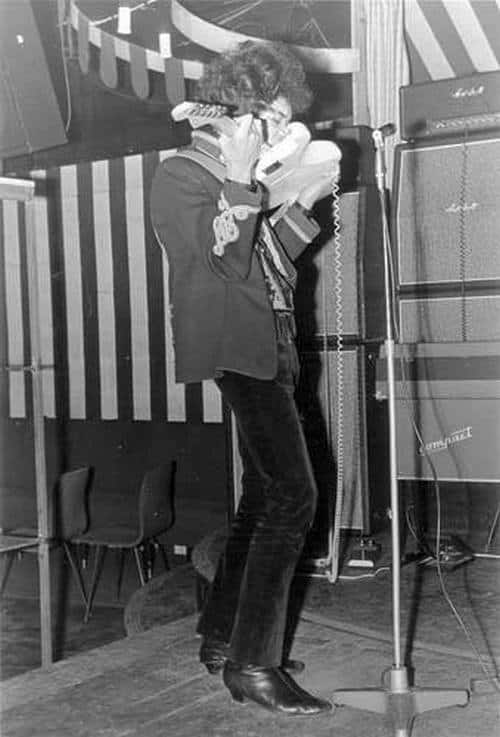
Jimi Hendrix with Marshall Supa Fuzz. January 24, 1967, The Marquee Club. Photo source: www.themarqueeclub.net From the photo above we can see that Jimi’s Supa Fuzz was a 1966 version, or MKI, with control knobs closer together than on the MKII model. This model was based on the Tone Bender MKI circuit, with a modified tone circuit to give the Marshall version a different sound. Interestingly, on this MKI model of the Supa Fuzz, the fuzz was internally fixed at maximum.
21967Roger Mayer Octavia
Continue Reading 1967Jimi started using this pedal around January 1967, after meeting Roger Mayer – an acoustic engineer working for the British Admiralty who as a hobby designed and built effect pedals for guitars, when they were still virtually unknown.
In case you’re unfamiliar with the functionality of the Octavia pedal, in Roger’s own words Octavia “produces a sound that is an octave higher than the note you are presently playing.” The effect is somewhat subtle, but if you watch a few YouTube videos, you should be able to tell the difference. A good starting point is this ProGuitarShop Demo video.
According to Roger Mayer, he first met Jimi at the Bag O’ Nails club in central London – probably around January 1967. This time frame is important to establish because by that time Jimi had already released Hey Joe, and was about to release Purple Haze and Fire. The tracks were mostly finished, but upon learning about the Octavia, Jimi decided to overdub the solos.
Vox V846 Wah Pedal (Woodstock)
Continue ReadingThroughout his career, Jimi used a number of different wah pedals. However, it’s often hard to tell which one he was using on a particular occasion because of the low-quality footage on some of the concerts.
Fortunately, on one occasion that perhaps matters the most to some, that is the Woodstock festival in 1969, the type of the wah used is somewhat well established.
According to Dave Weyer, who at the time worked on Jimi’s equipment, the wah pedal that he used that day was a modified Vox V846, made in the Sepulveda factory in California.
Jimi had a box of wah pedals, and I had, over the course of the year, worked on every one. But Jimi’s favorite was the yet-to-be-seen by the public, Sepulveda model with the TDK inductor and the high beta Motorola transistors. It can be identified by the lack of a Vox logo on the front, the relief where the logo was supposed to be glued on, a West Coast sticker on the bottom, and Jimi’s signature on the inside of the casing wall, applied at a difficult angle, but identifiable nonetheless — and, of course, the things he loved the most, the low noise and the sharp sweep, clearly audible in the Woodstock recordings.
Jimi Hendrix’s Wah-wah Pedal and Amp in J. Levine’s New Year’s Day Auction
111969Shin-ei/Univox Uni-Vibe
Continue ReadingJimi Hendrix used this effect most famously during the Woodstock festival on August 18, 1969. As far as studio use, the pedal was most famously featured on Machine Gun, but Jimi did use it extensively on other songs as well (see comments below).
The history behind this pedal doesn’t seem to be all that established, as different sources claim different origin stories.
The most commonly accepted version is that this pedal was designed by Japanese audio engineer Fumio Mieda sometime in the mid-1960s, as an attempt to emulate the sound of a rotating Leslie speaker. The pedal was initially designed to work with organs, as Fumio was mainly interested in keyboard instrument. As a little side note, in 1967, Fumio was approached by Tsutomu Katoh, the founder of KORG, for whom he would build the company’s first programmable organ.
31969




Jimi Hendrix's Strings
Fender Rock N’ Roll 150 Strings
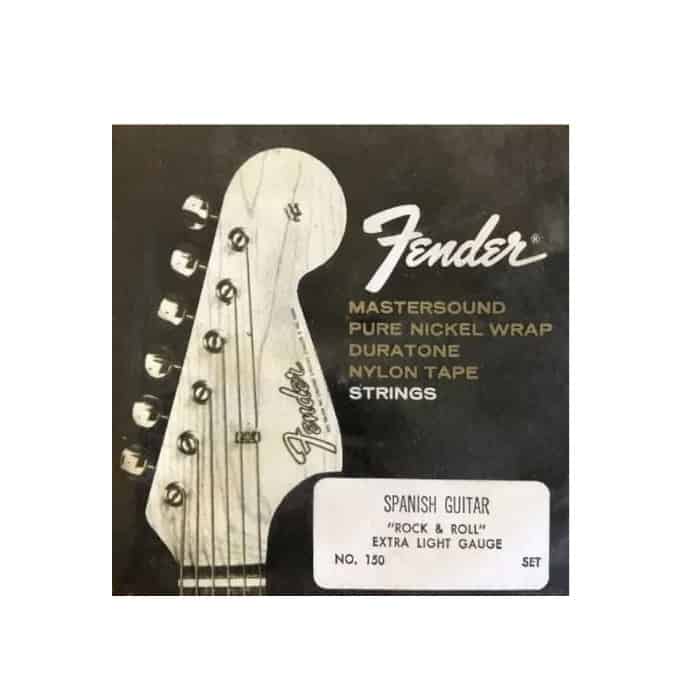
Continue ReadingAccording to Roger Mayer, Jimi used the standard Fender 150 set (.010, .013, .015, .026, .032, .038).
We were using the normal one, not the very high radius but definitely curvy. The actual strings we used were not what people would expect. The string gauges would run .010, .013, .015, .026, .032 and .038.
The Secrets of Jimi Hendrix’s Guitar Setup: Interview with Roger Mayer
The Fender 150 referred to a complete set sold at the time (late sixties early seventies). In Fender Catalogs From 1953 to 1979 (specifically from 1968) you’ll find the information that Fender branded the set as “Spanish Guitar light gauge Rock ‘N’ Roll”, and that the set included the following strings:
- 151 E-1st, Plain .010”
- 152 B-2nd, Plain .013”
- 153 G-3rd, Plain .015”
- 154 D-4th, Wound .026”
- 155 A-5th, Wound .032”
- 156 E-6th, Wound .038”
3----
Jimi Hendrix's Accessories
Ace (Woodstock) Guitar Strap
Continue Reading 1967During the Woodstock Festival gig on August 18, 1969, Jimi used a guitar strap with a very unique pattern, catching the eye of many. The strap was made by a company named Ace, who at the time produced a number of different guitar straps with similar designs.

Image source: Jimi Hendrix YouTube Jimi Woodstock strap was auctioned in 2008 for an undisclosed price (if you happen to come across anything related to the strap post-auction, be sure to leave a comment below).
Fender Medium Celluloid Guitar Pick
Continue Reading 1968This seems to be the pick that Jimi used most of the time. Looking through the photos, one can usually notice that he holds a red/black pick in his hand. This is probably Fender’s (more likely) or possibly Manny’s Music (probably used just on occasion), 351 shape celluloid pick.
These picks were used by most of the guitarists in the late 60s, and are in fact still popular today among the people who prefer vintage equipment. You can grab a pack on Amazon at – Fender 351 Shape Medium Classic Celluloid Picks.
Ace (Stained Glass) Guitar Strap
Continue ReadingHendrix was seen using this Ace guitar strap most notably in late October 1968, at the TTG Studios, LA. For photos, check our Pinterest page at Jimi Hendrix’s Ace Stained Glass Strap.
If you’re looking to buy one for yourself, Dunlop makes a pretty decent replica – check it out here Dunlop Jimi Hendrix ITG Studios Guitar Strap (JH08).
11968Manny's Music Medium Guitar Pick
Continue ReadingAlthough Jimi probably used a number of different picks in his career, a few of them have popped up recently on auctions / at museums. These few should mostly serve just as pointers, which suggest that Jimi simply preferred medium thickness picks, but didn’t seem to have a strong brand or model preferences.
This particular pick, which was handed down to Larry Lee, together with Jimi’s Les Paul Custom, recently popped up on Reverb.com – and you can see some of the photos here – 1969 Jimi Hendrix owned Manny’s Music Guitar Pick from Larry Lee w/ Woodstock ticket & COA. Please note that although the info seems to suggest that the pick was used during Woodstock, it clearly wasn’t. This can be concluded by looking through photos taken during Jimi’s performance that day (he used red/black colored picks).
11969Ace (Floral) Guitar Strap
Continue Reading 1970This was one of the several Ace guitar straps that Jimi used on his guitars (most famous one being the one that he used during Woodstock).
This particular strap (or at least one of them – Jimi could’ve owned several of the same model) was sold recently at an auction for an undisclosed price. It was previously owned by a guy named Darrel Stroot, who apparently got it in 1970 at the Roberts Municipal Stadium.
On June 10, 1970 I went to Evansville, IN to attend a concert. I was located near the stage during the performance. It was a good show. During the show, Jimi’s guitar strap broke. A stage-hand came out to replace it while he was playing; he tossed it onto the stage and the show went on. When the concert ended I went to the stage and asked a stage-hand for the strap; he acknowledged and the strap was mine. The strap has been in my possession since June 1970.


This gear list is a result of years of research and constant updates. It's a hobby project with the goal to eventually have the most complete and thorough gear list on the web - but that is only achievable with your help!
GroundGuitar counts on your criticism and feedback. If you have any knowledge or notice any mistakes, be sure to let us know!