Quick Answer: To record Nevermind, Kurt Cobain used a mix of cheap and reliable gear – a 1969 Fender Mustang, a 1965 Fender Jaguar, a Mosrite Gospel Mark IV, a Stella acoustic, and some cheap Stratocasters he didn’t mind destroying. His main amps were a Mesa Boogie Studio Preamp paired with a Crown Power Base 2, a Fender Bassman, and occasionally a Vox AC30. For effects, he mostly stuck with a Boss DS-1, a ProCo Rat, a Big Muff Pi, and an Electro-Harmonix Small Clone.
If you’re here to learn more, this article breaks down all of Kurt Cobain’s gear used on the album, followed by detailed song-by-song notes.
Kurt’s Guitars on Nevermind

Kurt’s main guitars on Nevermind were a 1969 Fender Competition Mustang, a 1965 Fender Jaguar, and a Mosrite Gospel Mark IV. The Mustang was still completely stock during the sessions, though it was later modified with a Seymour Duncan Hot Rails pickup and a Tune-o-Matic bridge. The Jaguar had DiMarzio pickups and became one of Kurt’s most-used studio and live guitars.
For acoustic work, he used a Stella H912 12-string guitar, which he had bought for twenty bucks in a Denver junk shop. He removed the extra strings and used it as a six-string. According to Krist Novoselic, Kurt had to tighten the tuning keys with pliers to keep the guitar remotely playable. That same guitar was used on both “Polly” and “Something in the Way.”
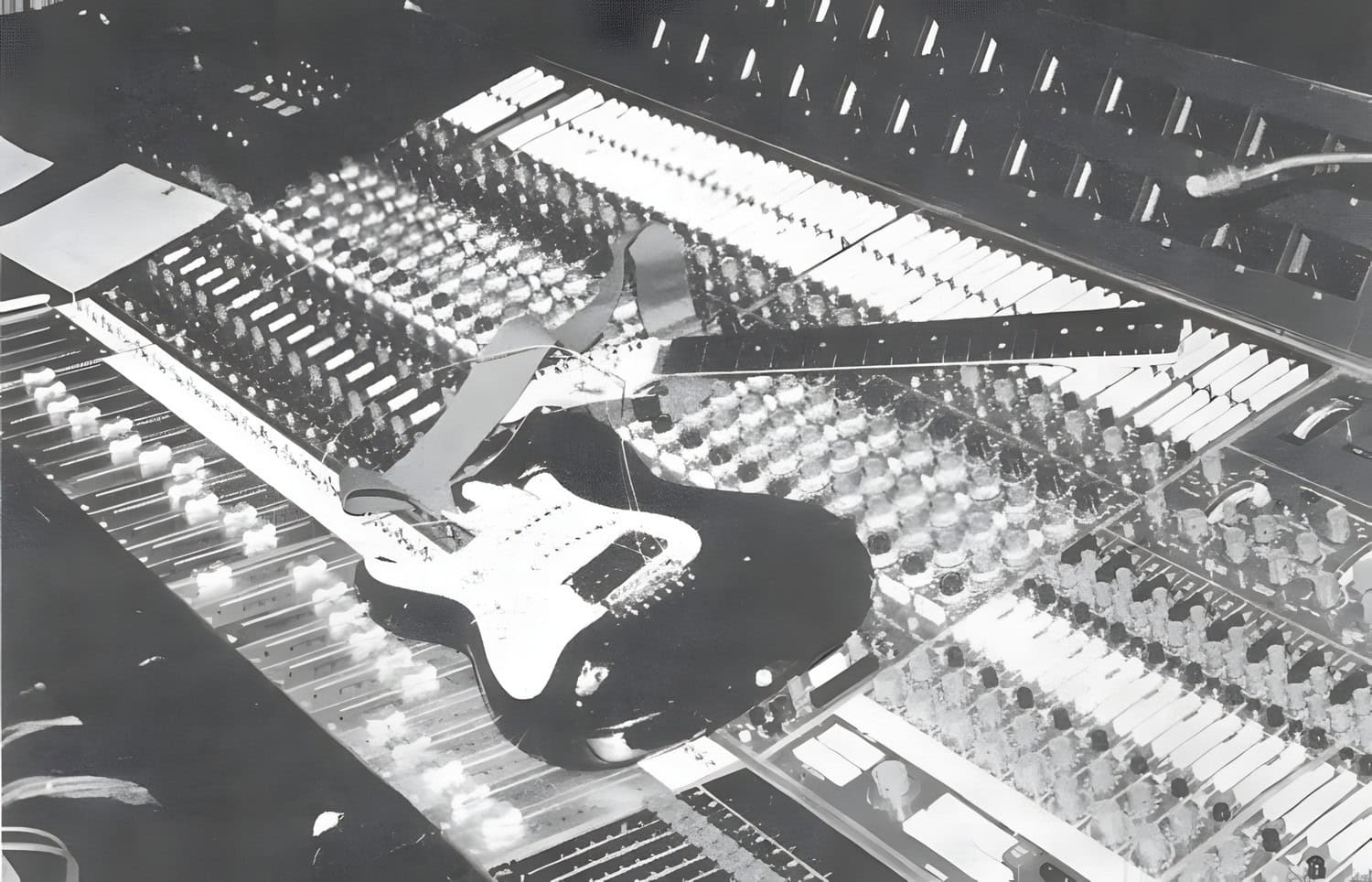
There were also a few Stratocasters around, mostly cheap ones. One of them, a black Strat, was famously smashed at the end of “Endless, Nameless,” and can be seen destroyed in photos from the Smart Studios.
Kurt’s Amps on Nevermind

Kurt used a few different amps to track the guitars on Nevermind, switching setups depending on the section of the song. For verses and cleaner parts, he often used a Mesa Boogie Studio Preamp, running it into a Crown Power Base 2. For choruses or heavier overdubs, the go-to was a Fender Bassman. The blend of these two amps gave the songs a dynamic shift – tight and focused in the verses, thick and saturated in the choruses.
Butch Vig also mentioned using a Vox AC30 on the record, particularly for clean overdubs and strummed sections. The amp helped retain bottom end without sounding overly processed by effects. Most of the cleaner tracks that sound airy or chiming likely went through the Vox.
All the clean guitars and strummy stuff that was I’m sure the Vox AC30.
Butch Vig Talks Recording Nirvana’s Nevermind
Kurt’s Effects on Nevermind

Kurt’s pedalboard was straightforward. The primary distortion came from a Boss DS-1, which was used throughout the album. The typical setting had the tone knob around 10 o’clock, distortion at 4, and the level maxed out. This was his default gain sound for rhythm parts.
The ProCo Rat was another key piece. It was used differently depending on the track – sometimes through an amp, sometimes directly into the console via DI. On “Breed” and “Territorial Pissings,” the guitar signal was split after the Rat, with one path going through an amp and the other directly into the board.
Modulation effects were limited. The EHX Small Clone was used for the clean, wobbly guitar tone on “Come As You Are” and in the pre-chorus of “Teen Spirit.” On “Lithium,” Kurt used a Big Muff Pi to get a darker, fuzzed-out sound. The clean intro has some chorus as well, though it’s unclear whether it came from the Small Clone or the AC30’s natural color.
Song-by-Song Breakdown
Smells Like Teen Spirit
On “Smells Like Teen Spirit,” Kurt played the 1969 Fender Mustang – the same one seen in the music video. He played through a Fender Bassman amp, using the DS-1 for distortion and the EHX Small Clone for the modulation heard during the solo and verse parts.
Kurt used an Electro-Harmonix Small Clone as one of the effects on the prechorus buildup to “Teen Spirit.” The Small Clone was the key to the chiming guitar sound heard on the song.
Butch Vig – Classic Rock Albums: Nirvana – Nevermind
In Bloom
“In Bloom” was built around two tones – one for the verses and one for the chorus. Kurt played through the Mesa Boogie Studio Preamp during the verses, then switched to the Bassman for the bigger, layered chorus sections. The DS-1 distortion pedal was likely used throughout.
Come As You Are
“Come As You Are” is the track most associated with the EHX Small Clone. The modulated clean tone heard in the verses and pre-chorus was done using that pedal. The amp on this track was most likely the Vox AC30, based on Butch Vig’s notes about clean overdubs.
He had an Electro-Harmonix Small Clone. That’s the watery sound you hear on the guitar in the verse and pre-chorus buildup.
Butch Vig – Classic Rock Albums: Nirvana – Nevermind
Breed
“Breed” featured a more experimental approach. The main guitar tone came from a ProCo Rat pedal, which was split into two signals, one running into an amp and the other straight into the recording console via DI. This created a layered, aggressive tone.
Unique to “Breed” was also Vig’s use of a U89 Neuman microphone for Kurt’s vocals.
At the time, I thought of using this one [rather than a U67] because he was singing higher and pushing the limits of his voice up. I just thought we needed more body to it.
Butch Vig
Lithium
On “Lithium,” Kurt used the EHX Big Muff to get the fuzzy, thumping tone. The clean intro may have included some chorus, though most of the weight came from the Bassman. Vig recalled using a U87 mic on the cabinet to pull a rounder tone.
Endless Nameless
“Endless Nameless” was recorded at the end of a session when Kurt lost his temper over a bad take, which explains its chaotic tone and unplanned inclusion. The guitar he used was the black Stratocaster seen smashed in photos from Smart Studios. There’s no clear record of the amp setup, but given the timeline, it was probably still the Mesa Boogie Studio Preamp or the Bassman.
Polly
“Polly” was the only track from the Smart Studio sessions that made it onto the final album. Kurt recorded it in one take using the Stella acoustic. The guitar had the same strings it came with, so old that Butch Vig described them as “plunky.” They mic’d it with an AKG 414, and that was it.
Kurt just sat in there and did it on his acoustic guitar. We recorded ‘Polly’ here in half an hour flat. I just recorded it with an AKG 414 microphone. The strings were so old they didn’t have any tone to them. A real plunky sound. It was the original strings. He never changed them.
Butch Vig – Classic Rock Albums: Nirvana – Nevermind
That’s a twenty-dollar junk shop Stella [a brand of low-cost guitars]. I didn’t bother changing the strings (laughs). In fact, I had to use duct tape to hold the tuning keys in place.
Kurt Cobain – 1992 Guitar World
Territorial Pissings
“Territorial Pissings” had a similar signal split as “Breed.” Kurt’s ProCo Rat went into both an amp and a DI, with the two signals blended together. Three takes were recorded, and the third one ended up being used.
Drain You
“Drain You” was a bit more complicated. Kurt started off using the Mesa Boogie with different guitars, but the tone came out too scratchy. He then switched to the Bassman, running a Rat pedal into it, and did a few more takes. Two of those ended up being used in the final mix.
The early passes sounded scratchy and grating, and the way he was playing didn’t sound very good.
Butch Vig
Lounge Act
On “Lounge Act,” Kurt recorded two separate guitar tracks through the Bassman, one clean and one heavily distorted. These were layered in the mix to give the song more movement between sections.
Stay Away
“Stay Away” doesn’t have a specific gear attributed to it in the sources, but it was most likely recorded using the standard DS-1 + Bassman or Boogie setup.
On a Plain
“On a Plain” was tracked live using the Bassman. Cobain recorded a live guitar part for the song using the “grungy” Bassman amp. Then he added a little bit more guitar on the chorus. Novoselic recorded an ambient-sounding bass part that complements the song’s mood.
Something in the Way
“Something in the Way” used the same Stella acoustic heard on “Polly.” Kurt recorded it while lying on the couch, strumming softly. They captured it again with an AKG 414, using the guitar’s dead strings and duct-taped tuners.
Krist Novoselic Gear on Nevermind
Krist Novoselic brought relatively minimal gear to the Nevermind sessions. His main instruments were two Gibson Ripper basses, one black and one blonde. For amplification, he primarily used an Ampeg SVT 400 bass amp. While he also had Peavey and Fender 2×15 bass amps with him, it’s unclear whether those were actually used during the recordings.
Dave Grohls’ Gear on Nevermind
Before the sessions started, Butch Vig brought in Ross Garfield, known as the Drum Doctor, to supply Dave Grohl with a full Tama Artstar II kit. The setup included a massive 16×24-inch kick drum, a 12×15-inch rack tom, and a 16×18-inch floor tom. The kit was provided through an endorsement deal from Tama, arranged just in time for recording.
The standout element of the kit wasn’t the shells, though – it was the snare. Nicknamed “The Terminator,” it was a 6.5×14-inch bell brass Black Beauty snare drum that weighed five times more than a standard steel model. Vig credits that snare as being one of the defining elements of the Nevermind sound. It was used on every track except “Polly” and “Something in the Way.” According to Garfield, it delivered a deep low-end with just enough crack on top to punch through the mix, which was exactly what the band was after.
For miking, Vig usually placed a Sennheiser 421 or an Electrovoice RE 20 close to the batter side of the kick drum. To capture some room and depth, he added an FET 47 about five feet out.
I typically put a Sennheiser 421 or an Electrovoice RE 20 close to the batter bass drum head. Then I put an FET 47 microphone about five feet away.
Butch Vig
Microphones and Vig’s Recording Approach
To capture Kurt’s guitar tone, Butch Vig typically used three microphones on the amp: a Shure SM57, a Neumann U87, and an AKG 414. Sometimes he’d swap in a Sennheiser 421 instead. Although all three were recorded, he usually ended up choosing just one for the final mix. To fine-tune mic placement, Vig would crank the amp with no guitar plugged in and listen to the hiss, treating it like a white-noise signal to check for phase coherence. He avoided using room mics and aimed for a tight, upfront sound. Most of the guitars on the record were mixed to feel dry and direct, with very little ambience.
I put three mikes on [Kurt’s guitar], a 57, a U87, and a 414. Or sometimes a 421. And then I would pick just one of those mikes.
A way I liked to check the mikes was to turn the amp on full blast, but with no guitar plugged in. So you get the hiss coming out of the speaker, which, in essence, is a white-noise signal that you can use to fine tune microphone placement by listening to the phasing. I don’t like a lot of room ambience. I prefer the guitars to be really in your face.
Butch Vig


There’s no such thing as a “Mosrite Gospel Mark IV” and the original Mosrite company never made a Mark IV guitar. Gospel was a brand used by Mosrite for slightly premium standard models marketed towards the religious market. The Mark V designation indicated a budget guitar. The guitar was a Gospel-branded Mosrite Ventures Model Mark V. The only differences between the Mosrite and Gospel versions was that the Gospel Mark V had no neck plate and had Japanese tuners.
Kurt didn’t use the 1969 competition mustang on nevermind, I believe there is list of insured guitars from just after nevermind was recorded and the comp-stang isn’t on that list there’s a video on the YouTube channel NirvanaGuitars that covers the topic
Kurt used his mosrite on songs tuned down to d standard.
Nice you mention the ProCo RAT — I’ve got a story about that. Back when Nirvana was practicing in Hell’s Kitchen, Curt used my RAT all the time. They ran my Ibanez RG450 straight into it. One day, he told me he couldn’t find a RAT that sounded like mine and asked if I’d take a walk with him to meet this guy named Bill — or at least stop by the music shop where he got his gear serviced — to ask about my RAT and why the circuit board was completely covered in epoxy.
Turns out the epoxy was there either to resist heat or to hide modifications, because the RAT I had was modded by none other than Bill Finnegan, who later went on to create the KLON Centaur. Looking back, I realize now that the RAT I had was, in some way, a KLON in disguise.
Recently, I played a few of Curt’s songs again, and let me tell you — that tone was definitely there.
Sadly, I sold the pedal years ago to a pawn shop called Easy Cash in Charleville, France. We were traveling in an RV, and I thought, “Eh, it’s just another RAT someone hacked, they all sound the same.” Big mistake.
The closest I’ve gotten to that RAT sound since is with a DemonFX KLON clone — I am convinced its a KLON..I later heard Curt recorded with this guy who worked with Smashing Pumkings and they USED the RAT I had as well, instead of a combo of pedals Billy had used on his previous record.
Was that guy who worked with Smashing Pumpkins Butch Vig