1963 Gibson Firebird III

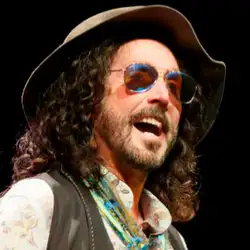
Mike Campbell is best known as Tom Petty’s longtime lead guitarist, first in Mudcrutch and later in Tom Petty and the Heartbreakers. His playing was rarely built around extended solos or heavy effects. More often, it came from short melodic parts, sharp rhythm figures, and guitar sounds that left space around Petty’s vocal.
Campbell’s gear history reflects that approach. Some instruments stayed with him for decades, while others were pulled in for a particular song, session, or tour. His heavily modified “Red Dog” Telecaster, Rickenbackers, Gretsch guitars, and various vintage Fender-style instruments all point to a player who used guitars for specific textures rather than sticking to one fixed setup.
The list below gathers the guitars, amps, effects, and other equipment linked to Campbell through interviews, photos, videos, studio notes, and live appearances.
Tom Petty originally played this Gibson Firebird III in the music video for “You Don’t Know How It Feels.” Mike Campbell later used the guitar on several songs, including “Jammin’ Me,” “Refugee,” “Breakdown,” “American Girl,” and “I Won’t Back Down” during America: A Tribute to Heroes. He also played it on “Mary Jane’s Last Dance” at Tom Petty and the Heartbreakers’ 2002 Rock and Roll Hall of Fame induction performance.
The guitar is most closely associated with Campbell’s live performances of “Runnin’ Down a Dream.” Beginning in 1999, Petty and Campbell often used matching Firebirds for the song, with Petty playing a 1976 Bicentennial Firebird and Campbell playing this Firebird III.

Mike Campbell bought his 1950 Fender Broadcaster at Nadine’s Music, on the corner of Santa Monica Boulevard and Vine Street in Hollywood, at a point when the band was still scraping by. At the time, he only had a Firebird and a Fender Twin Reverb, while Tom Petty was using Campbell’s sunburst Stratocaster through a late-1950s Fender Tweed Deluxe. Campbell felt they needed more gear before trying to bring the band into Denny Cordell’s sessions.
He spotted what he thought was a Telecaster, but the salesman explained it was actually a 1950 Broadcaster, an early pre-Telecaster Fender model. The salesman had him plug it into a blackface Fender Deluxe Reverb, and Campbell immediately felt it was “his sound.” The price was $600, which was a fortune for him at the time, since he was making about $60 a week and his wife Marcie was pregnant.
It was beautiful, with a maple neck and a one-piece ash body with a rich butterscotch finish and a black Bakelite pickguard. It had brass bridge saddles, with a white-cloth wrapped bridge pickup with raised pole pieces and a slim silver neck pickup. I tried to look around at other guitars but kept coming back to stare at it.
The salesman took the Broadcaster down and handed it to me. It was light. The neck fit my hand perfectly. I strummed an A chord; it rang like an acoustic. The ash body was loud and clear, and the neck vibrated softly in my hand.
Mike Campbell [3]

In 1977, Mike Campbell was looking through the Recycler ads in Los Angeles for a deal on a 12-string Rickenbacker. He found an ad for a “Rickenbacker 12-string” and went to a suburban home expecting to see a hollow-body model similar to the one George Harrison played. Instead, the guitar turned out to be a small solid-body 1963 Rickenbacker 625/12 prototype in Fireglo.
Although it was not the model he had been looking for, the price was low enough that he bought it for roughly $150.
Campbell only learned much later that the guitar was historically significant. According to him, it was the next 12-string Rickenbacker off the production line after George Harrison’s instrument.
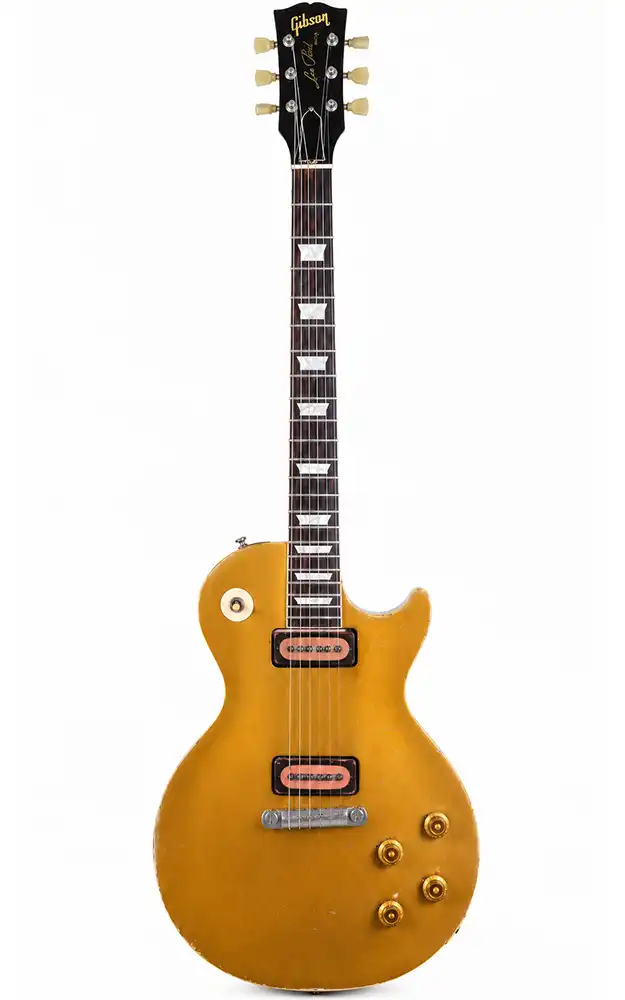
Mike Campbell bought this Les Paul at Nadine’s Music in L.A. on the same day he bought his Broadcaster. According to Campbell, the two guitars cost around $500 or $600 each. In the past, he sometimes had refered to the guitar as a 1968 model, but based on its features it appears to be an early 1972 Gibson Les Paul Standard 58/54 Reissue rather than an actual 1968 Les Paul.
Gibson actually called it a 58 reissue for reasons unknown. Most of these came with a stop tail-piece like a 53/54 goldtop and some actually came with a tune-o-matic bridge and tailpiece like a 56 gold top. Also some of these came with a sunburst finish.
I walked out of Nadine’s that day with my 1950 Fender Broadcaster and my 1972 Gibson 1954 reissue Goldtop – a gorgeous, glimmering Les Paul with a fat neck, a wraparound tailpiece, and roaring single coil P90 pickups.
I thought the pickups had been swapped out because they looked different and exotic, with exposed coils of thin red wire wrapped around the fat alnico magnets. They hadn’t been though. Somebody had just removed the cream covers. Gibson had called it a 1958 reissue, but the wraparound bridge was true to 1954. It had a mahogany body with a maple cap and cream binding.
It complemented the Broadcaster perfectly. The Fender screamed and the Gibson snarled. I was set. What other guitars would I ever possibly need?
Mike Campbell [1]

Mike Campbell bought this mid-1960s Gretsch 6186 Clipper in Hartford on the same day he purchased the Gibson SG Junior later used on “Runnin’ Down a Dream.” The Clipper can be seen in the “Jammin’ Me” music video, and Campbell used it to record the solo on “I Won’t Back Down.”
By the early 1990s, the guitar had been heavily modified. Its original single-pickup setup was replaced with two Firebird-style mini-humbuckers, and a Bigsby vibrato was added. The controls were also expanded with a second volume and tone control, along with a three-way selector switch in a Les Paul-style layout.
In the 2000s, the guitar was refinished in ice blue by Toru Nittono. In its fully modified form, the Clipper can be seen during performances of “Lost Children” and “Mary Jane’s Last Dance” on Live at the Olympic: The Last DJ, filmed at the Grand Olympic Auditorium in Los Angeles.

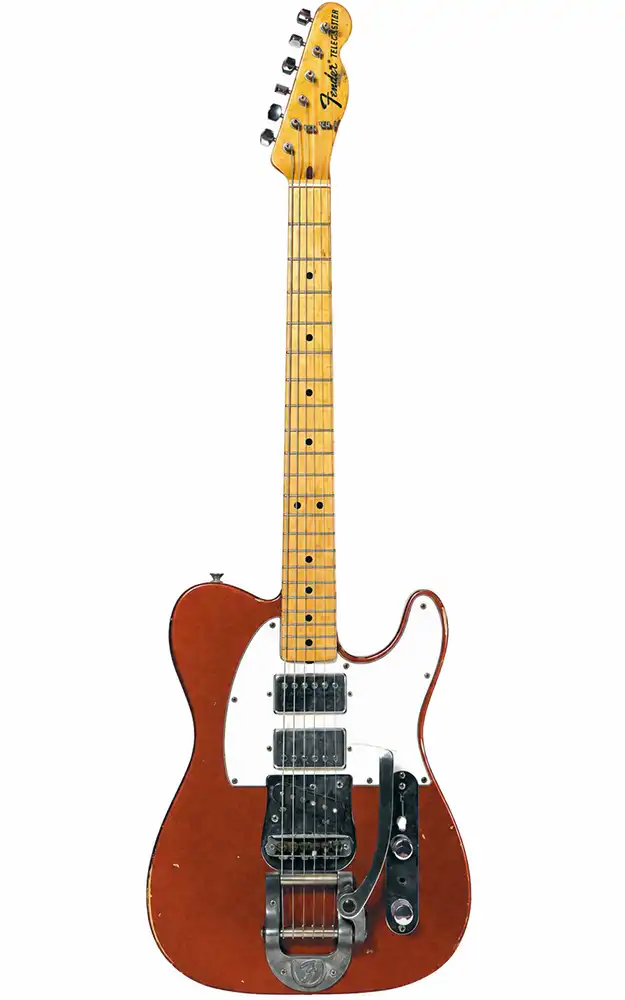
Mike Campbell’s “Red Dog” Telecaster is a heavily modified 1972 Candy Apple Red Fender Telecaster, and it became one of the key guitars in the Heartbreakers’ history. Mike bought it in Gainesville, Florida from one of his guitar students for around $200.
By that point, the guitar had already been changed quite a bit, with two humbuckers in the neck and middle positions, a Telecaster bridge pickup, a Bigsby vibrato, and a built-in boost switch known as the “Destruct” circuit.
Even though it was Mike’s guitar, both he and Tom Petty used it live. Tom can be seen playing it on “Dog on the Run,” and also during the band’s appearance on Fridays, where he used it for “Shadow of a Doubt (A Complex Kid).” Visually, it was hard to miss – a red Telecaster with a Bigsby, extra pickups, and a look that matched the rougher side of the early Heartbreakers.
Mike got this guitar while he was in Hartford, Connecticut on tour, and he went to a video store, that randomly happened to have a couple of guitars for sale. He bought them both, one of them being this SG Junior [1]
This most likely happened in 1986, because based on various wiki sources [2], Tom Petty had a concert in Hartford, Connecticut on July 11, 1986, which was during the 1986 True Confessions Tour, which was a concert tour by Bob Dylan and Tom Petty and the Heartbreakers.
The guitar was also damaged during that same tour, at The Forum in Los Angeles on August 3, 1986, when Campbell dropped it and it snapped the headstock off.
Check back soon.
Check back soon.
Check back soon.
Check back soon.
Check back soon.