Brian May's Guitars and Gear
Summary of Brian May’s Gear
What guitar does Brian May use?
Brian May plays the guitar called “Red Special”. He built this guitar around 1966 from the materials he had laying around the house, with the help of his father who was an electrical engineer. He used that guitar on all of the Queen’s albums and still uses it to this day.
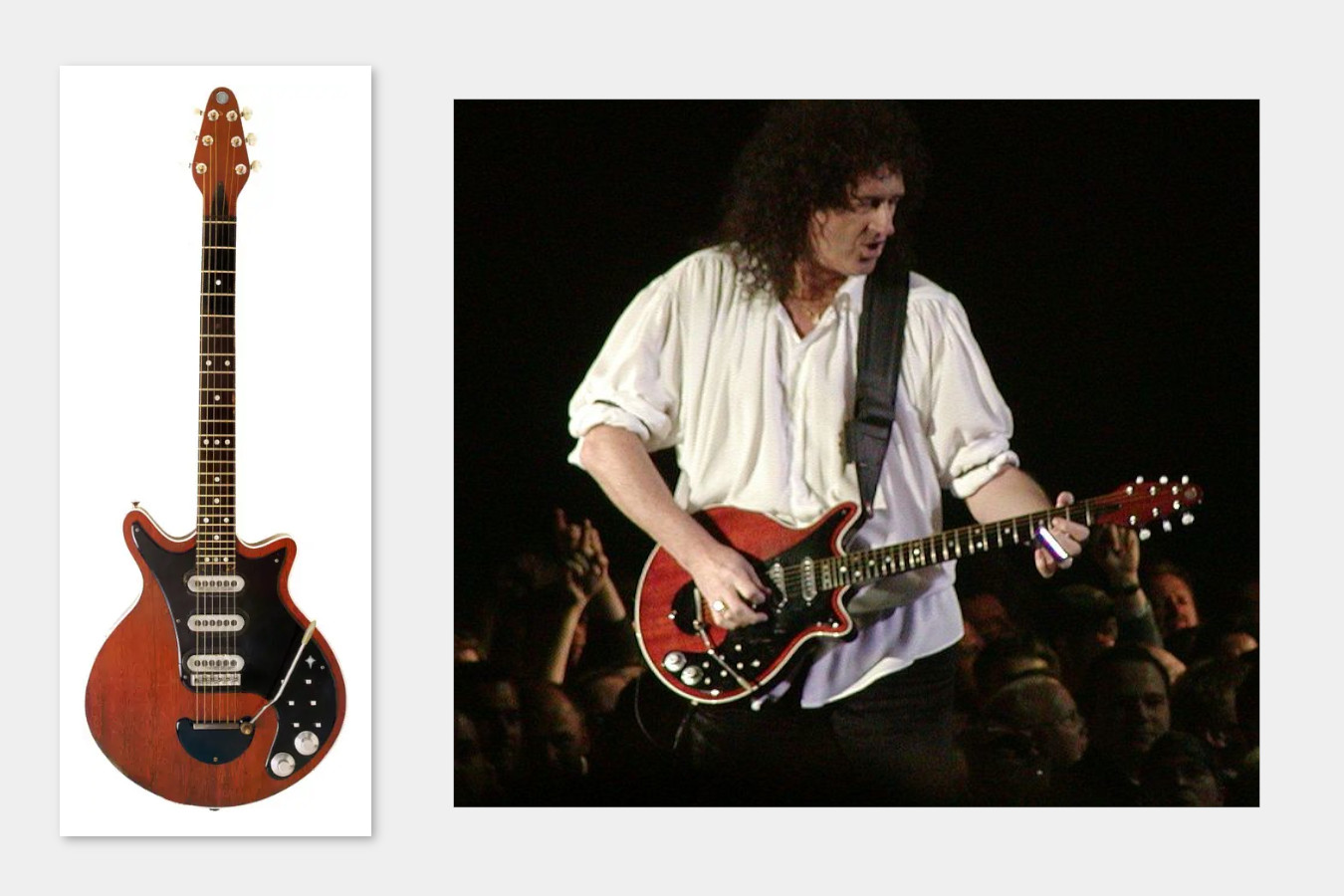
Over the years, he tried using other guitars, including a 1978 Fender Telecaster, a 1970s Fender Stratocaster, and a couple of different Gibsons, but he always ended up coming back to the old Red Special. These guitars were primarily used just as backups for the Red Special, up until the point people started producing replicas of that guitar for Brian to use instead.
The first replica was built by John Birch in 1975, but it ended up being not up to Brian’s expectations and was quickly disregarded. More recently, he settled on using a mix of replicas built by Greg Fryer and Andrew Guyton. He uses them as backups, or for special tunings when playing live.
What amp does Brian May use?
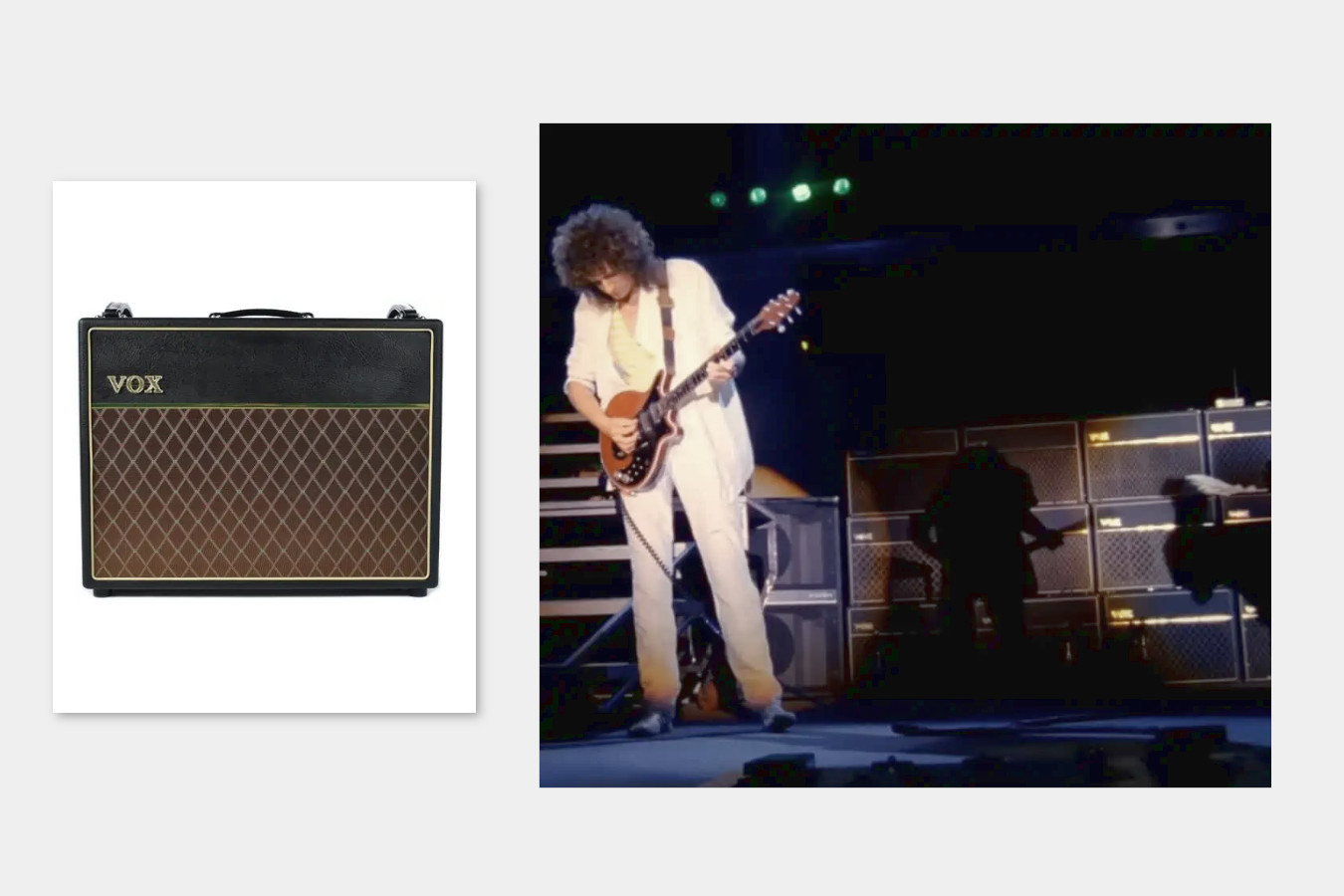
As far as the rest of Brian’s gig, things are equally simple. Brian runs his guitar through a treble booster, and into a Vox AC30 amp. The treble booster model that he used varied over the years, but he started out on the original Dallas Rangemaster.
Brian May’s guitar strings
For strings, Brian uses Optima 2028 BM 9s, which is his own signature set.
Does Brian May use a coin as a pick?
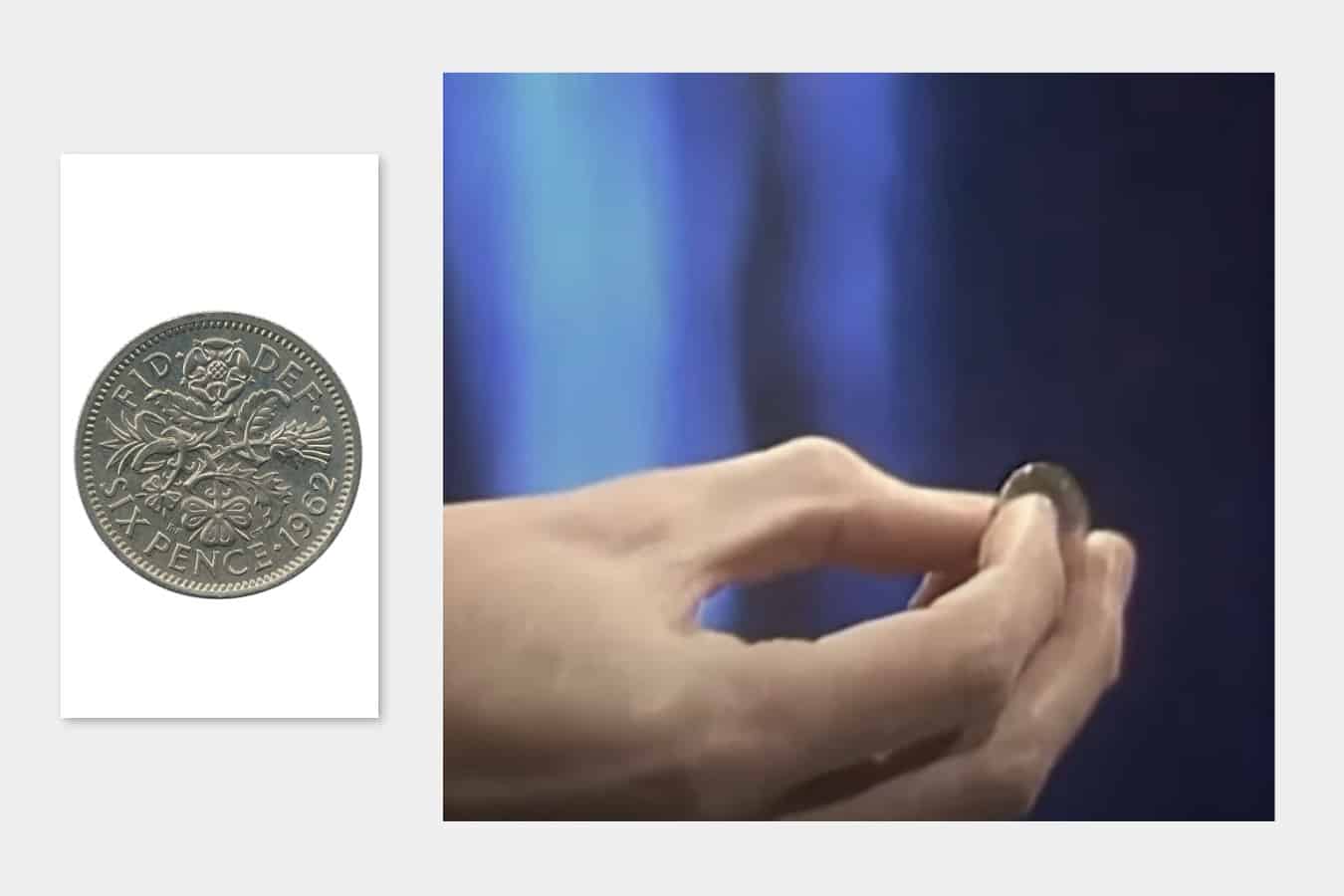
Yes, Brian uses an English sixpence coin as a guitar pick. He likes the rigidness of the metal coin, and he feels that gives him more control over the way he attacks the strings.
List of Guitars, Amps, Effects, and Accessories used by Brian May
Brian May's Electric Guitars
Red Special
 Continue Reading 1966
This is the guitar that Brian built together with his father Harold in the early 1960s, and the one that he used as his main recording instrument ever since. It is one of the most unique guitars in the history of rock music, because it’s the only guitar that was actually built by the guitarist himself from scratch, and used on albums and songs that reached billions of people at this point.

Brain playing his Red Special guitar. Live In Budapest 1986 The inspiration for building the Red Special, as Brian explained, came from the first acoustic guitar the he ever had – an Egmond parlor guitar. Brian played this acoustic for a while, even made a small pickup in order to “electrify” it at some point, but eventually together with his father, who was an electrical engineer, decided to try and make an actual electric guitar.
1970s Fender Stratocaster
 Continue Reading
Brian carried this Stratocaster as a backup on tour around 1974, which was before he had any replicas made of the Red Special.
Based on the maple neck and the headstock shape, the guitar was probably made sometime in the 1970s. Obviously, Brian started using it around 1973, so it had to have been made before that. The guitar also seems to have a clear finish, because the wood grain seems to be visible on some of the footage.

Queen performing at the TopPop Dutch TV show in 1974. But, aside from what can be concluded from the photos and the footage, not much can be said about the guitar. It’s unknown whether Brian still has it, or whether he got rid of it after 1974.
11973Gibson Les Paul Deluxe
 Continue Reading
Brian used this guitar shortly on tour around 1974-1975. It was mainly just a backup guitar for his Red Special, but it seems that Brian didn’t really like it all that much.
I used to think the Stratocaster would be the thing when I got one. Always thought when I got enough money to get one of those, that will be it. Then, when I got enough, I didn’t like it. The same with the Les Paul. I thought the Les Paul would be it.
6 July 1976 – Circus Magazine interview with Brian May
There’s really not a lot of info or footage of this guitar, so it’s largely a mystery. From the few photos that we have, it appears to be a Les Paul deluxe with two mini-humbuckers, with the body finished in red sunburst.

Brian May playing a Gibson Les Paul Deluxe, mid 1970s. 11975Burns Baldwin Double Six
 Continue Reading
Brian used this guitar on the song “Long Away” from Queen’s 1978 album A Day at the Races. According to him, the inspiration for the song came from just playing this specific guitar.
I used this on Long Away. Funnily enough I think I bought it because I liked the pickups, but I fell in love with the guitar once I started playing around with it and the song materialised. The guitar actually inspired the riff that powers the song.
This guitar is produced by Burns and features the exact same pickups that Brian used in his Red Special – the Tri-Sonics. This is, as noted in the quote above, the reason why Brian purchased the guitar in the first place. Also, it’s the exact same model that Elvis Presley pled in the movie “Spin Out”.
21975John Birch Red Special Replica
 Continue Reading
This is the first replica ever made of the Red Special. The guitar was made by John Birch in 1975 and became widely known after its appearance in the “We Will Rock You” music video.

The John Birch RS Replica guitar as seen in the “We Will Rock You” music video. Unfortunately, Brian didn’t really warm up to the guitar, because it didn’t sound like the original one, despite the fact it had the exact same pickups which he kept as spare. He did use it for a while as his backup guitar, until around 1982 when he threw it out of frustration and ended up damaging it.
119751978 Fender Telecaster
 Continue Reading 1979
This is the guitar that Brian often used to play Crazy Little Thing Called Love on tour with the Queen. He would usually start out on an acoustic Ovation guitar, and then in the second verse had his guitar tech hand him this black 1978 Telecaster.
On this guitar he would play the little fills in the verses and the first solo. Interestingly, during live concerts, Brain would switch back to his Red Special, and finish the song on that guitar – even though on the original recording it was all done on a Fender.

Brian playing “Crazy Little Thing Called Love” on a Fender Telecaster. Live at Rock Montreal, 1981 Gibson Flying V
 Continue Reading
Brian started using this Flying V as a backup for his Red Special in 1982 after the John Birch replica was damaged. Like most of Brian’s backup guitars back in those days, this guitar too ended up being just a necessity and was ditched right after the Hot Space Tour.
I also have a Flying V, which is a recent acquisition. I got it because I smashed up my Birch guitar. I got very frustrated with it one night and uncharacteristically threw it offstage. It happened to be a very high stage, and it smashed into lots of pieces.
Guitar Player magazine – January 1983, Interview by Jas Obrecht
Based on the few photos that are available of Brian with the guitar, his Flying V had a tobacco sunburst finish, white body binding, a stop-tail bridge, and two humbuckers with no metal covers.
A decent photo of Brian with the guitar, including a little bit of story behind the concert during which it was photographed, is available on Matt Granz’s Flickr page – it’s worth checking out.
11982Fryer Red Special Replica "John"
 Continue Reading 1997
Greg Fryer made this guitar for Brian in 1997, and ever since then, Brian has been using it as a backup for his original Red Special.
I wrote to Brian’s management with the objective of making for him the most accurate replica of his guitar to date, a guitar that he would consider worthy of using as a spare. After meeting with Brian in July 1996 to discuss the project, I then spent a very intense eighteen months thoroughly researching the parts materials components building techniques needed, obtaining everything I needed, and then building the three replicas at my workshop in Sydney.
This is one of three replicas that Greg made for May, the other two being “Paul” and “George Burns” (all three guitars have nicknames). According to Greg, “John” and “George Burns” remained with Bryan, while he got the keep the “Paul”.

Brian playing the replica nicknamed “John”. Notice how “fresh” the pickup covers and the finish looks. Fryer Red Special Replica "George Burns"
 Continue Reading 1997
This is one of three Red Special replicas built by Greg Fryer in late 1997. Brian kept two of those three, nicknamed “John” and “George Burns”, while the third one, nicknamed “Paul” remained with Greg.
This “George Burns” replica is distinguishable from the “John” by its color. It seems that Greg either used a different finish, which resulted in more of a yellowish tint, or that this was just a result of using a different type of wood for the body.

Brian playing the “George Burns” replica in 2004. In the early days, up until the 2010s, Brian used this guitar as his main drop-D tuning guitar, on songs such as “Fat Bottomed Girls”. In most recent years, he’s most often been using the Andrew Guyton green replica for that purpose and keeping the “George Burns” as a backup.
Guyton "Green Twin" Replica
 Continue Reading 2004
This is a replica of the Red Special built by Andrew Guyton. It’s one of the two prototypes built by Andrew in 2004 before he started producing a limited run of these guitars that could be purchased by the public.
Andrew started building the guitar in 2003, after having measured the original Red Special, and after having it X-rayed so that all the cavities of the body could be seen as well.
It was arranged for the guitar to be x-rayed at St.Barts hospital in London. With this new information. My aim was to make possibly the closest replica yet, not only had the x-rays shown the size and shape of the cavities, they also showed the method of securing the knife-edge and body/neck construction that simply hadn’t been available by general examination of the guitar.

Brian playing the Guyton green replica in 2014. Guyton "Badger" Replica
 Continue Reading 2014
This is one of the more recent replicas that Andrew Guyton made for Brian. The guitar got its nickname “Badger” from a little badger inlay on the pickguard. In case you’re wondering why – Brian has long advocated for the protection of wildlife and is fond of badgers in particular.

Brian May playing the guitar in 2014. The guitar is, of course, heavily based on the original Red Special, but it features some significant changes in this case. This replica features a carved maple arched top with an “F” hole – which was actually something Brian wanted to do on the original Red Special, but had no proper tools at that time. It also has a different bridge style, and it doesn’t have a tremolo but a fixed brass piece.
Brian uses this guitar to play the song “Crazy Little Thing Called Love” live. One thing that helps him with that, apart from the fact that the guitar is semi-acoustic, is that it has a piezo pickup installed below the bridge. This pickup makes the guitar sound almost like an acoustic when plugged into an amp.


Brian May's Acoustic Guitars
Egmond Student
 Continue Reading 1954
This was Brian May’s first guitar ever, which he got from his parents for his 7th birthday. As he explained during the “Red Special” book launch in 2014, this little Egmond acoustic guitar was the main inspiration for eventually building the Red Special together with his father.
At some point, Brian even made a pickup for the guitar and mounted it on top behind the soundhole.
The inspiration for the Red Special came from this little guitar. It was a present to me from my mom and dad for me 7 birthday – or so (around 1954).
There came a point when me and my dad said – well, it would be nice to have an electric gutiar, instead of this acoustic guitar. But – we had no money, we were really poor.
Hallfredth Acoustic Guitar
Continue ReadingBrian received this guitar from Dave Dilloway in exchange for his Egmond parlor guitar. Dave was Brian’s friend and bandmate – he played bass guitar in their band called “1984” from 1964 to 1968.
At some point after receiving the guitar, Brian modified it so it would sound more like a sitar. He did so by adding some fretwire before the bridge saddle, which the strings would vibrate against when played.
Yeah, I have a very old, cheap Hairfred which makes that buzzy sound that’s on “Jealousy” [Jazz] and “White Queen” [Queen II]. I’ve never seen another one like it.
I made it sound like a sitar by taking off the original bridge and putting a hardwood bridge on. I chiseled away at it until it was flat and stuck little piece of fretwire material underneath. The strings just very gently lay on the fretwire, and it makes that sitar-like sound.
Guitar Player magazine – January 1983, Interview by Jas Obrecht
Aside from the songs mentioned above, the guitar was also photographed among the band’s instruments during the Ridge Farm Studio rehearsals session in the summer of 1975. These rehearsals were of course in preparation for the “A Night at the Opera” studio sessions. However, it’s unknown whether Brian ended up using the guitar on any of the songs or not.
11967Ovation Pacemaker 1615 12-String
 Continue Reading
This is the guitar that Brian used to record Love of my Life, ’39, and the intro part on Crazy Little Thing Called Love. Since two of these three songs came from the same album, A Night at the Opera, that means that Brian likely acquired his first Ovation 12-string sometime just prior to the studio sessions, so around early to mid-1975.
As is his usual practice, he used the same guitar when performing the songs live with the Queen. However, in more recent years and tours, he switched to a Guild 12-string instead.

Freddie and Brian singing/playing Love of my Life, Montreal 1981. 11975Gibson Chet Atkins CE
Continue ReadingBrian used this guitar live with the Queen for the song Is This The World We Created?, from the band’s twelfth studio album The Works released in 1984.
I used that live for [Is This The World We Created?] and I have a feeling that’s the guitar on the record too, but I wouldn’t swear to it.
Brian May on 9 Queen guitars that aren’t his Red Special

Brian playing his Gibson Chet Atkins CE Classical guitar, Budapest 1986 Please note that in the statement above, Brian originally said that he used the guitar on the song Who Wants To Live Forever. However, since there’s no classical guitar in that song, and since there’s actual footage of him using the guitar on Is This The World We Created? it’s more likely that Brian simply was either misquoted or listed the wrong song.
11986Guild JF-6512/F-412
Continue Reading 2005Brian used this guitar most notably during the 2005/06 Queen + Paul Rodgers Tour as his main 12-string acoustic guitar.

Brian with the Guild 12-string in 2005, during the Paul Rodgers tour. The guitar is likely a Guild F-412 model, based on the fact that it has maple sides. It could also be the JF-6512 if the guitar was made earlier than 2002. It’s essentially the same exact model, but F-412 was re-named the JF-65M-12 in the late 80s and was renamed back to F-412 in 2002.
Guild F-512
 Continue Reading 2014
This is the guitar that Brian has been most recently on stage for songs such as “Love of my Life” and “’39”. In the past with the Queen, he usually used an Ovation Pacemaker 1615.

Brian playing a Guild F-512 12-string acoustic guitar in Tokyo in 2014. Please note that Brian also owns a Guild F-412/JF-65, which is basically an arched maple-back version of this guitar, while this guitar, the F512, has a rosewood back (and sides).


Brian May's Amps
Deacy Amp
 Continue Reading 1972
This is a little amp made by Queen bassist John Deacon in 1972 that Brian used for studio recording on songs such as “Killer Queen”, “Procession”, “Wedding March”, and “Good Company”.
For those orchestral things, I’ve usually used a Vox AC-30 as well as a small amplifier which was made by John Deacon. This has a little hi-fi speaker cabinet which is about a foot by six inches, and John put a little transistor amplifier inside it. I use it with a treble booster which overloads it. It just makes a good noise; I don’t know why.
Interview with Brian May “Guitar Player” magazine – January 1983
John, who at that time was an electronics engineering student, apparently found pieces in a trash bin of what was eventually discovered to be a Supersonic PR80 portable radio. He made a small speaker box for it and connected it to a 9-volt battery, and the famous Deacy amp was born.
VOX AC30
 Continue Reading 1975
Brian’s main amp with the Queen and in the most recent years has always been a Vox AC30.
I always use a Vox AC-30 amp, except for those instances where there’s a particular orchestra sound and I’ve used a small amplifier.
I use old Vox AC-30s that have tubes instead of transistor. These have a very flexible, identifiable sound without much coloration. […] They use tubes biased in a Class A range. Most guitar amplifiers are Class B, which means they have more inherent distortion in them at lower levels. The Vox AC-30s are very clear at low level and then gradually and smoothly go into a nice distortion.
Interview with Brian May “Guitar Player” magazine – January 1983
When playing live, nowadays he usually uses 9 AC30s on stage. According to Brian’s guitar tech, the three amps on the very top are “dummies” and not in use, and the middle three are there as spares, in case something goes wrong with one of the 3 bottom ones that are actually in use.

Brian may with a wall of Vox AC30 amps, Live in Budapest 1986


Brian May's Effects
Treble Booster
 Continue Reading 1974
Brian used a variety of different treble boosters in his career, starting of course with the original Dallas Rangemaster.
Apparently, as a young guitarist, he really like how Rory Gallagher sounded, and at some point approached him and asked him what kind of gear he uses. That’s when he discovered the Vox AC30, and the Rangemaster, which both of course were the staples of Rory’s sound.
He had the grace to speak to us, and I said “how do you get that sound?”. He said “you know, it’s very simple, I have this little amp, AC30, and I have this little treble booster”. So I went straight out and got myself and AC30 and a Rangemaster treble booster.
It was Rory who gave me my sound, and that’s the sound that I still have. That’s my voice.
If you want to learn more about Rory’s sound and gear, we have a dedicated page on the topic – Rory Gallagher’s Guitars and Gear.
Dunlop CryBaby Wah Pedal
 Continue Reading 2014
Brian was seen using one of these during the 2014 tour, as can be seen in the Guitarist Magazine rig rundown linked in the quote below.
The only thing we have up front is a good old Wah-Wah pedal. Everything else I do from there [backstage].
Pete Malandrone – On The Road with Brian May of Queen Guitarist Magazine


Brian May's Strings
Rotosound Guitar Strings
 Continue Reading 1979
Based on the statement that Brian gave in the January 1983 issue of Guitar Player at that time he used Rotosound strings. The gauges were .008, .009, .011, .016, 0.22, and .034. These were quite common back in the day and were used by various artists stationed in the UK like Jimi Hendrix and Pink Floyd.
Optima 2028BM Electric Guitar Strings
 Continue Reading
These seem to be the strings that Brian uses on his electric guitar in more recent years. The set carries Brian’s name in the branding, which means it’s the official signature set.
The strings measure: .009, .011, .016, .024, .032, .042. – which is a significant step up compared to the old Rotosound strings that he used in the past.
12004


Brian May's Accessories
Sixpence Guitar Pick
 Continue Reading 1980
In the very early days, Brian used a regular plastic pick, that based on his statements, was on the lighter side. Eventually, he switched to using an English sixpence, and never looked back.
I used to use very bendy strings because I thought they were better for speed. But, I gradually discovered that I wanted more and more hardness in the pick. The more rigid it is, the more you feel what’s happening in the strings at your fingers.
Brian May -Talks about his Red Special, Picking, J.Deacon & Stereoscopy -Radio Broadcast 03/10/2014
Brian also explains how he likes the serrated edge on the coin, as this provides him with more unique ways to hit the strings and make unique sounds.
I play with an English sixpence. It’s a coin made of soft metal with a serration on the edge. I hold it loosely between the thumb and the first finger, with the first finger bent down.
Interview with Brian May “Guitar Player” magazine – January 1983


This gear list is a result of years of research and constant updates. It's a hobby project with the goal to eventually have the most complete and thorough gear list on the web - but that is only achievable with your help!
GroundGuitar counts on your criticism and feedback. If you have any knowledge or notice any mistakes, be sure to let us know!