Greatest Album Covers of All Time – From 1967 to 2021
Album cover art in the past was a unique experience. It was not only about the music, but the artwork was also part of the journey. The covers were full-sized,…
StoriesIn 1993 Johnny Depp and Gibby Haynes, the lead singer of the Butthole Surfers, decided to do a short documentary about a young guitarist who went from being an internationally acknowledged musician to spending his days mostly secluded, painting various images and phrases that came to his mind over the walls of his house in Hollywood Hills.
The two allegedly first hung around John’s house for a couple of days and discussed his music and art, but surprised and shocked by the state of the house that Frusciante was living in decided to put it all on film.
The result is a documentary called “Stuff” – a 10-minute watch, but even in such a short time frame successfully capturing the climate that John was living in at this period of his life. You can see cryptic writings and images all over the house painted by Frusciante, who was obviously very influenced by Jean-Michel Basquiat. Every wall served as a canvas, and no place was safe from being used as a temporarily thought holder.
Just about everything about his house tells a story of a man who completely stopped doing all the stuff that an average person does. He created an atmosphere of complete freedom and anarchy, starting from ignoring all the basic household rules as to where does a person put his trash, or what purpose does a floor serve (in his case for trash disposal). There’s papers and plastic bottles everywhere, guitars behind couches and leaning on kitchen appliances, mirrors painted over with brushes, and bathrooms “decorated” with blood stains.
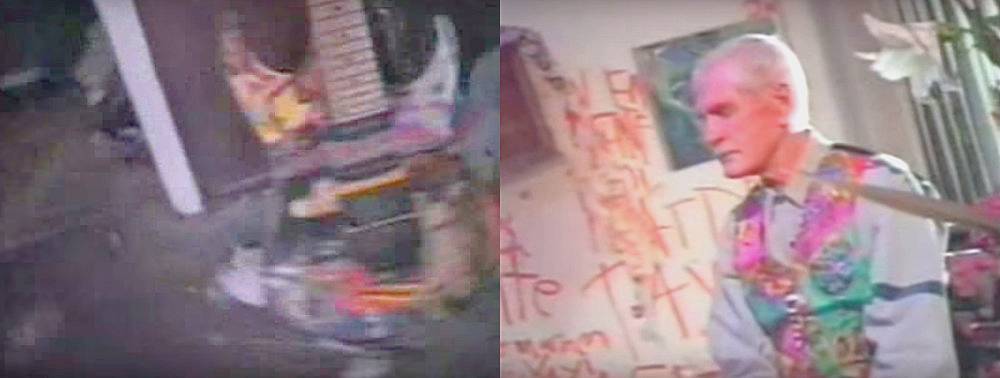
But this wasn’t just a life of an artist trying to jump away from the circle that most people are stuck in, but also a life of a heroin addict. John developed a serious drug habit during his four-year tenure with the Red Hot Chili Peppers. This escalated in 1992 when he left the band and entered a deep depression forcing him to a life of even more drugs and almost complete isolation from people.
For a long time, he focused on painting and writing short stories and screenplays. His heroin use of course increased and eventually spiraled into a life-threatening dependency which resulted in a near-death experience from a blood infection. His arms became scarred from the improper and extensive use of needles, which left him with permanent abscesses.
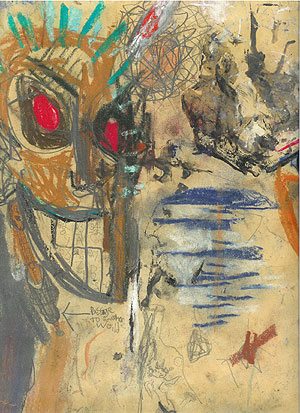
After a couple of years of him living under these conditions, his house in Hollywood Hills was eventually destroyed by a fire that claimed most of his guitar collection, and some of his musical material. Nevertheless, he kept the drug habit alive until 1997, when he checked into a drug rehabilitation clinic in Pasadena on the initiation of his friend Bob Forrest. Since then he’s been clean from drugs, and from a perspective of many – a completely different person.
John re-joined the Red Hot Chili Peppers in late 1998, and by the next year recorded the album “Californication” with the band – which was a complete change of direction for them.
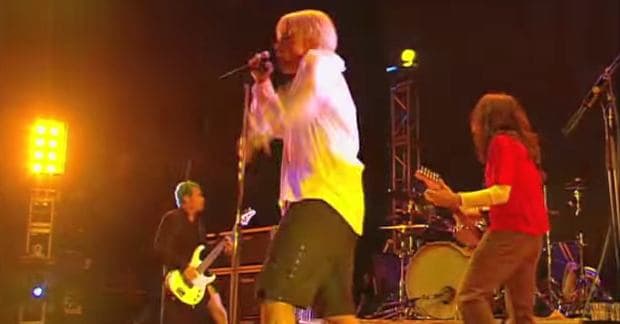
The overall sound and feel were more mellow and relaxed, with songs such as “Road Trippin'” and “Scar Tissue” surprising many of the fans of band’s previous works. Few of them protested, but most of the people welcomed the change and the band even managed to attract a whole new audience of people that pushed the album to a 5× Platinum status in the United States alone.
A band that was thought by many to be a thing of the past became even bigger, and all through the simple magic of change and a newly discovered love for life. Californication was followed by the 2002 album By The Way, and eventually Stadium Arcadium in 2006. The chemistry between the four members seemed to be on a whole another level during live shows, which was perhaps best seen during the Slane Castle concert filmed in 2003.
In 2009 Frusciante announced that he’s leaving the band once again to focus on his life and solo career. We haven’t gone into to much research about his current whereabouts, but from the looks of it, he seems to be living a pretty happy life surrounded by good friends and fruitful thoughts.